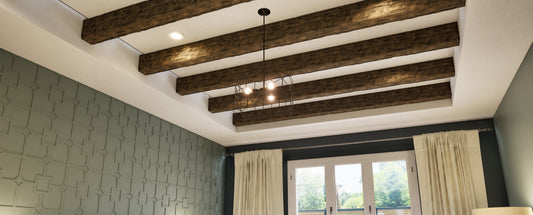
Weather-Resistant Ceiling Materials for Covered Patios

Key Takeaways
- Faux polyurethane beams deliver the look of real wood with zero rot risk, UV resistance, and a 25+ year outdoor lifespan.
- Stretch ceiling membranes are 100% waterproof and create a seamless finished look under fully covered patio structures.
- Sacramento's extreme heat swings (35°F winter mornings to 108°F summer afternoons) demand materials rated for thermal cycling.
- Natural tongue-and-groove wood remains popular but requires resealing every 2–3 years to prevent warping and moisture damage.
- Composite/PVC boards and aluminum soffit panels offer the lowest maintenance profiles for patio ceilings in Northern California climates.
- Material costs range from $3/sq ft for basic beadboard to $18+/sq ft for premium backlit stretch ceiling installations.
A covered patio extends your home's living space—but only if the ceiling overhead holds up to the elements. Here in Sacramento and the greater Bay Area, that means accounting for triple-digit summer heat, winter fog that saturates surfaces for weeks, and wildfire seasons that blanket neighborhoods in fine ash. The wrong ceiling material peels, warps, or fades within a few seasons. The right one looks sharp for decades with minimal upkeep.
This guide breaks down six proven patio ceiling materials—covering lifespan, maintenance cycles, installed cost per square foot, and how each performs under Sacramento Valley conditions. For a broader look at outdoor ceiling and beam options, see our complete Outdoor Ceiling & Patio Beam Guide.
Why Material Choice Matters More Outdoors
Indoor ceilings live in climate-controlled environments. Outdoor ceilings face a different reality: direct UV bombardment, temperature swings of 70°F or more across a single day in peak summer, wind-driven rain under partially covered structures, and persistent moisture from Valley tule fog between November and February.
Sacramento sits in USDA Hardiness Zone 9b, with average summer highs regularly cresting 100°F. Surface temperatures on dark-colored ceiling materials can reach 140–160°F in direct afternoon sun. This thermal cycling causes expansion and contraction that loosens fasteners, cracks rigid panels, and degrades adhesives over time. Any material you choose needs to accommodate this movement without visible damage.
Wildfire smoke introduces another variable. Fine particulate matter and ash settle on horizontal surfaces, and acidic residue from smoke can etch finishes on unprotected aluminum and natural wood. A material with a sealed, non-porous surface cleans up faster and resists permanent staining.
Faux Polyurethane Beams: The Best All-Around Outdoor Performer
High-density polyurethane faux wood beams have become the go-to choice for patio ceilings among Sacramento homeowners who want authentic timber character without the maintenance burden of real wood. These beams weigh just 1–2 pounds per linear foot—roughly one-tenth the weight of solid Douglas fir—making them easy to install on existing patio covers without structural reinforcement.
Performance Specs
- Lifespan: 25+ years outdoors, with no rot, insect, or moisture damage.
- UV Resistance: Factory-applied UV stabilizers prevent fading and chalking. Color retention typically holds for 10–15 years before a refresh coat is advisable.
- Weight: 1–2 lbs per linear foot, depending on profile size (4×6, 6×8, 8×10, etc.).
- Thermal Movement: Polyurethane expands and contracts less than wood, so joints stay tight through Sacramento's extreme temperature cycles.
- Fire Rating: Class A fire-rated options available—a meaningful consideration given Sacramento's proximity to wildfire zones.
Cost and Installation
Installed cost runs $8–$15 per linear foot for standard profiles, with premium hand-stained custom finishes pushing toward $18–$22. Most patio beam installations take 1–2 days for a standard 200–400 sq ft covered patio. The beams mount to a simple cleat system—no heavy hardware or specialized labor. Our installation team handles the full process, including cutting custom miters for vaulted or hip-roofed patio covers.
Best Applications
Faux beams work on virtually any covered patio configuration: flat ceilings, tongue-and-groove decking between beams, gabled covers, and even attached pergola rafters. They excel at creating a cohesive indoor-outdoor transition—matching the same beam profile used inside your living room or kitchen to the patio ceiling outside.
Stretch Ceiling Membranes: Seamless, Waterproof, Modern
Stretch ceilings bring a completely different aesthetic to outdoor spaces—a smooth, monolithic surface with no seams, joints, or visible fasteners. Made from UV-stabilized PVC membrane tensioned into a perimeter track, these systems are 100% waterproof and resist mold, mildew, and moisture vapor.
Performance Specs
- Lifespan: 15–20 years outdoors under a solid roof structure. UV-stabilized membranes resist yellowing for 10+ years.
- Waterproofing: Impervious to water. If condensation or a roof leak occurs above, the membrane holds the water like a basin until drained—protecting furniture below.
- Acoustics: Micro-perforated options reduce echo on hard-surface patios, making conversation easier in partially enclosed outdoor rooms.
- Thermal Performance: The air gap between the membrane and the structural ceiling provides a layer of insulation, reducing radiant heat transfer on hot days.
Cost and Considerations
Installed cost ranges from $10–$18 per square foot, depending on finish (matte, satin, or lacquer) and whether integrated lighting is included. For outdoor applications, we recommend fully covered structures—a solid roof overhead, not a pergola with open slats. While the membrane handles rain and moisture, prolonged direct UV without a roof covering will shorten its aesthetic lifespan.
One significant advantage for Sacramento homeowners: after wildfire smoke events, stretch membranes wipe clean with a damp cloth. No pressure washing, no resealing, no smoke-stain absorption.
Tongue-and-Groove Natural Wood: Classic Look, High Maintenance
Cedar, redwood, and pine tongue-and-groove planks remain the traditional choice for covered porches and patios across Northern California. The warm, natural grain is undeniably attractive—and for many homeowners, nothing else feels quite right.
The trade-off is maintenance. Natural wood exposed to outdoor conditions—even under a solid roof—needs resealing or restaining every 2–3 years. Skip a cycle, and you'll see cupping, warping, and checking within 12–18 months, especially on the south-facing sides that absorb the most heat. Sacramento's low winter humidity followed by tule fog saturation creates a wet-dry cycle that's particularly punishing on unsealed wood.
Performance Specs
- Lifespan: 10–20 years with consistent maintenance. Cedar and redwood outperform pine by 5–8 years on average.
- Maintenance: Seal or stain every 2–3 years. Sand and refinish every 7–10 years. Budget $1.50–$3.00/sq ft per maintenance cycle.
- Cost: $5–$12/sq ft installed, depending on species. Cedar runs $7–$10; pine at $5–$7; redwood at $9–$12.
- Fire Resistance: Low, unless treated with fire-retardant coating (adds $1–$2/sq ft). A real consideration in Sacramento's wildfire-prone foothills.
If you love the look of real wood but want to avoid the upkeep, consider pairing faux beams with a composite or PVC plank system between them. You get the warmth of timber framing without any of the wood-on-wood maintenance stacking.
Composite and PVC Ceiling Boards: Low Maintenance, Moderate Cost
Composite boards—made from a blend of wood fiber and plastic polymers—and solid PVC boards occupy the middle ground between natural wood and fully synthetic materials. They offer wood-like appearance with dramatically reduced maintenance requirements.
Performance Specs
- Lifespan: 20–30 years outdoors. Manufacturers like TimberTech and AZEK warranty against rot, warp, and structural defects for 25+ years.
- Maintenance: Annual cleaning with soap and water. No sealing, staining, or painting required.
- Cost: $6–$11/sq ft installed. PVC runs slightly higher than wood-plastic composite.
- Thermal Movement: Composite boards expand more than wood with heat. Installers must leave 1/8" to 3/16" gaps at butt joints to prevent buckling—critical in Sacramento's summer heat.
- Appearance: Modern composites feature embossed wood grain that's convincing from 3–4 feet away. Up close, they lack the depth and variation of real timber or high-end faux beams.
Composite boards pair well with faux wood beams as infill panels. The beams provide the structural visual framework, and the composite planks fill in between—a combination that delivers high style with the lowest total maintenance cost.
Aluminum Soffit Panels: Commercial Durability for Residential Patios
Aluminum soffit panels are the workhorse of commercial patio and canopy ceilings—shopping centers, restaurant terraces, hotel pool areas. Increasingly, homeowners are borrowing this material for its virtually zero-maintenance profile and clean, modern aesthetic.
Performance Specs
- Lifespan: 30–50 years. Aluminum doesn't rot, warp, crack, or support mold growth.
- Maintenance: Essentially none. Rinse with a hose annually. Powder-coated finishes resist fading for 15–20 years.
- Cost: $4–$8/sq ft installed for standard vented or solid panels. Premium woodgrain-printed aluminum runs $8–$12/sq ft.
- Ventilation: Vented soffit panels allow airflow above the ceiling plane, reducing heat buildup in the roof structure—valuable for Sacramento's scorching summers.
- Fire Resistance: Non-combustible. Meets the highest fire ratings without any additional treatment.
The drawback: aluminum soffit panels look like aluminum soffit panels. Even woodgrain-printed versions read as commercial to most eyes. For homeowners prioritizing warmth and character, pair aluminum panels with decorative faux beam wraps at key intervals to break up the industrial feel.
Beadboard: Traditional Porch Charm with Paint Maintenance
Beadboard—narrow planks with a distinctive center bead—defines the classic American porch ceiling. Painted "haint blue" or crisp white, it evokes Craftsman and Victorian character homes found throughout Sacramento's Midtown, Land Park, and East Sacramento neighborhoods.
Performance Specs
- Lifespan: 15–25 years for PVC/cellular beadboard; 10–15 years for wood beadboard with consistent maintenance.
- Maintenance: Wood beadboard needs repainting every 3–5 years. PVC beadboard is essentially maintenance-free beyond occasional cleaning.
- Cost: $3–$7/sq ft installed. Wood beadboard at $3–$5; PVC/cellular beadboard at $5–$7.
- Style Fit: Best suited to traditional, Craftsman, farmhouse, and cottage-style homes. Reads out of place on modern or Mediterranean patio designs.
Pro tip: if you love the beadboard look but hate paint maintenance, go with cellular PVC beadboard from the start. It costs $2–$3 more per square foot upfront but eliminates every future repaint cycle. Over a 20-year span, the PVC option costs less total.
Material Comparison: Side-by-Side Overview
The table below summarizes each material across the metrics that matter most for Sacramento-area covered patios.
|
Material |
Cost/Sq Ft (Installed) |
Lifespan |
Maintenance |
UV Resistance |
Fire Rating |
Sacramento Suitability |
|
Faux Polyurethane Beams |
$8–$15/lin ft |
25+ years |
Very Low |
Excellent |
Class A available |
★★★★★ |
|
Stretch Membrane |
$10–$18/sq ft |
15–20 years |
Very Low |
Good (covered) |
B1 rated |
★★★★☆ |
|
T&G Natural Wood |
$5–$12/sq ft |
10–20 years |
High |
Poor |
Low (untreated) |
★★★☆☆ |
|
Composite/PVC Board |
$6–$11/sq ft |
20–30 years |
Low |
Good |
Moderate |
★★★★☆ |
|
Aluminum Soffit |
$4–$12/sq ft |
30–50 years |
None |
Excellent |
Non-combustible |
★★★★★ |
|
Beadboard (PVC) |
$5–$7/sq ft |
15–25 years |
Low |
Good |
Moderate |
★★★★☆ |
|
Beadboard (Wood) |
$3–$5/sq ft |
10–15 years |
Moderate |
Poor |
Low |
★★★☆☆ |
Sacramento Climate Challenges: What Your Patio Ceiling Faces
Extreme Heat and Thermal Cycling
Sacramento averages 73 days above 90°F and roughly 15 days above 105°F annually. Surface temperatures on dark-finished ceilings can exceed 150°F in direct sun. This heat drives expansion in every material, but the overnight cool-down to 60–65°F in summer forces contraction back. Over thousands of cycles, rigid materials crack at joints, fastener holes elongate, and adhesives fatigue. Faux polyurethane beams and stretch membranes handle this cycling better than most alternatives because both materials flex rather than fracture.
Valley Wildfire Smoke and Ash
Wildfire season (June–November) regularly degrades air quality to hazardous levels in the Sacramento Valley. Ash deposits settle on every outdoor surface, and smoke residue contains organic acids that can permanently stain porous materials. Sealed, non-porous surfaces like stretch membranes, aluminum panels, and coated faux beams wipe clean. Unsealed natural wood absorbs smoke particulate into the grain, creating discoloration that sanding alone may not fully remove.
Winter Tule Fog Moisture
From November through February, tule fog can keep relative humidity above 90% for days at a stretch. This persistent moisture saturates unsealed wood, promotes mildew growth on organic surfaces, and accelerates corrosion on unprotected metal fasteners. Materials with factory-sealed surfaces and stainless-steel or hot-dipped galvanized fasteners resist fog-related degradation far better. If you're using natural wood, apply a marine-grade sealant (Penofin, TWP, or similar) rated for continuous moisture exposure.
How to Choose the Right Material for Your Covered Patio
Selecting a patio ceiling material comes down to four factors: your budget, your design style, how much maintenance you're willing to commit to, and the specific exposure conditions of your patio structure.
- Want the warmth of wood with zero upkeep? Faux polyurethane beams. They replicate hand-hewn timber, stained barn wood, or smooth contemporary wood finishes—and you'll never sand, seal, or repaint them.
- Want a sleek, modern, seamless surface? Stretch ceiling membranes. Ideal for fully covered outdoor rooms, especially paired with integrated LED lighting for evening entertaining.
- Building on a tight budget? PVC beadboard or standard aluminum soffit panels keep costs under $7/sq ft installed while delivering solid performance.
- Designing a high-end outdoor living room? Combine faux beams with stretch membrane infill panels for the ultimate mix of character and refinement. This is the approach we install most often for premium patio projects in Granite Bay, El Dorado Hills, and Danville.
Not sure which direction fits your project? Our in-home consultation includes an on-site assessment of your patio structure, exposure conditions, and aesthetic goals—plus material samples you can see and touch in your actual space.