Ceiling Design Ideas: Room-by-Room Inspiration for Every Style

Most homeowners spend weeks agonizing over paint colors, flooring, and furniture — then barely glance up. That blank white surface overhead? It's roughly 20% of a room's visible surface area. Interior designers call it the "fifth wall," and for good reason: your ceiling has an outsized influence on how a space feels, sounds, and functions.
This guide walks through ceiling design ideas for every major room in your home, from dramatic living room statements to moisture-proof pool enclosures. Each section includes specific materials, finish options, lighting strategies, and real-world considerations for Sacramento Valley and Bay Area homes — where everything from summer heat loads to seismic requirements shapes what works best overhead.
Whether you're building new construction in Elk Grove, renovating a 1960s ranch in Walnut Creek, or updating a downtown Sacramento loft, the right ceiling treatment can redefine the entire room.
Why Your Ceiling Matters More Than You Think
Walk into any high-end hotel lobby or a well-designed restaurant, and your eyes instinctively go up. The ceiling anchors the entire design narrative — it determines whether a room reads as intimate or expansive, modern or rustic, calm or energetic. In residential spaces, this principle applies just as directly.
The Fifth Wall Effect
The concept of the ceiling as the "fifth wall" emerged from interior design practice in the early 2000s, but architects have understood its importance for centuries. A standard 8-foot flat ceiling reads as neutral — functional but invisible. Raise that to 9 or 10 feet, add a recessed tray detail, or install a glossy stretch ceiling that reflects light, and the same square footage suddenly feels 30% larger. Conversely, a wood-beamed ceiling in a room with 12-foot ceilings brings the proportions back to human scale, creating warmth without sacrificing volume.
Light, Acoustics, and Property Value
Ceilings directly control how light moves through a room. A matte white surface absorbs and diffuses light evenly. A glossy stretch ceiling reflects it like a mirror, bouncing natural daylight deeper into the space — particularly effective in Sacramento homes where strong afternoon sun can be redirected rather than blocked. Translucent and backlit ceiling panels turn the entire overhead plane into a luminaire, eliminating shadows entirely.
Acoustics matter too, especially in open-concept floor plans that dominate Bay Area new construction. Hard, flat ceilings bounce sound from the kitchen into the living area and back again. Acoustic stretch ceilings with micro-perforated membranes reduce reverberation by up to 70%, letting you hold a conversation at the dining table while someone runs the blender ten feet away.
From a resale perspective, distinctive ceiling treatments consistently rank among the top interior upgrades that buyers notice during walkthroughs. Appraisers in the Sacramento and Bay Area markets note that custom ceiling work — particularly integrated lighting and architectural beam details — contributes to the overall "finished" impression that supports higher valuations.
Living Room Ceiling Ideas
The living room carries more design weight than almost any other space. It's where you entertain, where natural light tends to be strongest, and where ceiling height varies the most across home styles. Sacramento ranch homes typically feature 8-foot flat ceilings, mid-century Eichler-style Bay Area homes often have sloped or beamed ceilings ranging from 8 to 14 feet, and newer construction in communities like Folsom and Roseville frequently includes vaulted great rooms topping out at 18 feet or more.
Stretch Ceilings for Modern Clean Lines
A matte or satin stretch ceiling delivers the seamless, flawless surface that modern and transitional living rooms demand. There are no visible seams, no joint tape ridges, and no popcorn texture to date the room. Installation takes a single day for an average living room (roughly 250–400 square feet of ceiling area), and the membrane mounts on a perimeter track positioned about one inch below the existing ceiling — meaning you lose almost no headroom.
For rooms that feel cramped or dark, a glossy lacquer stretch ceiling in a light neutral shade creates a reflective surface that effectively doubles the perceived ceiling height. We've installed high-gloss white membranes in Sacramento bungalows with 8-foot ceilings that made the rooms feel closer to 10. The reflection captures furniture, artwork, and ambient light, producing an effect that visitors consistently notice.
Faux Beam Ceilings for Warmth and Character
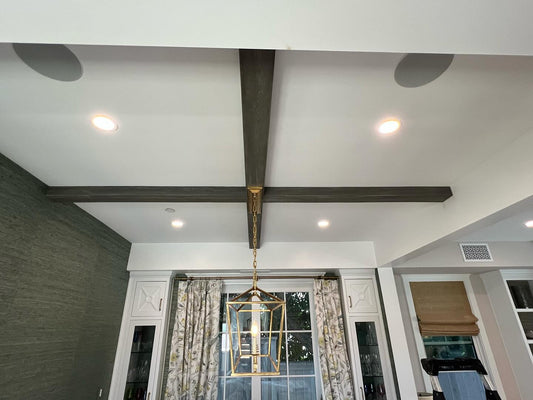
Faux wood beams bring architectural depth to living rooms without the structural cost and engineering that solid timber beams require. A single 8-inch by 8-inch box beam weighs approximately 2–3 pounds per linear foot versus 15–20 pounds for solid oak. That weight difference matters enormously in California, where seismic bracing requirements add cost to every pound suspended overhead.
The most popular configuration for living rooms: a grid of three to five parallel beams running the length of the room, finished in a hand-stained walnut or weathered gray. Paired with a warm white stretch ceiling between the beams, this combination bridges modern and farmhouse aesthetics — a look that resonates strongly with homeowners in the Sacramento Valley and wine country foothills.
Backlit and Tray Ceilings for Ambiance
Tray ceilings add architectural depth by recessing the center section 6 to 12 inches above the perimeter. When that recessed area is fitted with backlit stretch panels, the effect is transformative — a soft, even glow emanates from the ceiling plane itself, replacing the need for multiple recessed cans or table lamps. The LED strips behind the translucent membrane are fully dimmable and, in many installations, color-tunable from warm amber (2700K) to cool daylight (5000K).
For an even more dramatic statement, a 3D stretch ceiling introduces sculpted forms — gentle waves, geometric steps, or organic curves — that turn the ceiling into functional art. Browse our project gallery to see how these treatments come together in real Sacramento and Bay Area living room ceiling installations.
Kitchen Ceiling Ideas
Kitchens generate heat, moisture, grease vapor, and cooking odors — all of which rise straight to the ceiling. Any ceiling treatment in this room needs to withstand those conditions while still looking sharp under the bright, task-oriented lighting that kitchen work demands. Traditional drywall ceilings in kitchens yellow over time, absorb odors, and develop hairline cracks near the range hood from repeated heat cycling.
Moisture-Resistant Stretch Ceilings
PVC-based stretch ceilings are inherently moisture-resistant and non-porous, meaning they won't absorb grease, smoke, or steam. A quick wipe with a damp microfiber cloth restores the surface to its original finish — a maintenance advantage that resonates with Sacramento homeowners who know what 105°F summer days plus a working oven can do to a kitchen environment. The material also resists mold and mildew growth, an important consideration in Bay Area coastal-climate homes where humidity can spike.
Lighting Integration for Kitchen Workspaces
The most effective kitchen ceiling designs layer multiple light sources. A stretch ceiling makes this straightforward: recessed LED downlights install directly through the membrane using thermal rings that prevent heat damage. The typical kitchen layout places four to six recessed lights over the primary work zones (countertops, island, sink) supplemented by pendant fixtures over the island or breakfast bar.
For kitchens that open into the living or dining area — the dominant layout in Northern California homes built or remodeled in the past decade — the ceiling design needs to unify both spaces while subtly distinguishing them. A common approach: a backlit stretch ceiling panel over the kitchen work zone transitioning to a flat matte stretch membrane in the adjoining living area, with a slim faux beam marking the boundary.
Open-Concept Kitchen Ceiling Strategies
Open floor plans present a specific ceiling challenge — how to define zones without walls. Changing the ceiling plane achieves this naturally. Dropping the kitchen ceiling by 4 to 6 inches below the living room ceiling creates a visual boundary. Using a different finish (satin in the kitchen, matte in the living area) adds another layer of distinction. Color shifts work too: a warm gray ceiling over the kitchen against an off-white living room ceiling reads as intentional and designed, not arbitrary.
Bedroom Ceiling Ideas
The bedroom ceiling is the last thing you see at night and the first thing you see each morning. Unlike the living room or kitchen, where the ceiling often serves as a supporting player, the bedroom ceiling is experienced directly overhead from a resting position — making it perhaps the most intimately viewed surface in your home.
Starry Sky Ceilings for Master Bedrooms
A starry sky ceiling uses fiber optic strands threaded through a dark stretch membrane to create a canopy of tiny, twinkling lights that mimic a night sky. The effect ranges from subtle (50–80 points of light over a 200-square-foot master bedroom) to immersive (300+ fiber strands with varying diameters that create the illusion of stars at different distances). A dedicated light engine, typically hidden in the attic space or a closet, powers the fibers and can be set to static, gentle twinkle, or slow color-shift modes.
In Sacramento-area master suites, we frequently pair starry sky panels with a soft perimeter cove light in warm white (2700K). The combination provides just enough ambient illumination for nighttime navigation without breaking the starfield effect. It's the kind of detail that transforms an ordinary master bedroom into a retreat — one homeowner in Granite Bay described it as "sleeping under the Sierra sky, minus the mosquitoes."
Printed Ceilings for Kids' Rooms and Themed Spaces
Printed stretch ceilings open up virtually unlimited creative possibilities. For children's bedrooms, popular choices include sky-and-cloud murals, underwater ocean scenes, maps, galaxy photographs, and abstract geometric patterns. The printing is done with UV-resistant, latex-based inks on the membrane before installation, so the image won't fade, peel, or require touch-ups.
The practical benefit: when your child outgrows a theme (and they will), the membrane can be replaced in a few hours without touching the walls, floor, or electrical. It's far less disruptive and costly than repainting a hand-painted mural or stripping wallpaper from a ceiling.
Acoustic Options for Restful Sleep
Acoustic stretch ceilings use micro-perforated PVC or fabric membranes backed by a sound-absorbing layer. In bedrooms positioned above a home theater, garage, or ground-floor living space, these ceilings can reduce transmitted noise by 10–15 decibels — the perceived difference between hearing full conversations and hearing only muffled background murmur. For second-floor bedrooms in Bay Area townhomes with shared walls and hard floors below, this acoustic upgrade often makes the difference between restful and restless nights.
Bathroom & Spa Ceiling Ideas
Bathrooms generate more concentrated moisture than any other room in the house. A 10-minute hot shower produces roughly half a pint of water vapor — most of which rises and condenses on the ceiling. Over time, this moisture cycle causes drywall to soften, paint to blister, and mold to establish itself in the warm, dark space between the ceiling surface and the framing above. Standard exhaust fans help, but they don't eliminate the problem entirely.
Waterproof Stretch Ceilings
PVC stretch ceilings are completely waterproof — not just moisture-resistant, but impervious to water. In the event of a leak from a second-floor bathroom or a compromised roof seal, the membrane can hold up to 2 gallons of water per square foot, stretching to contain the leak rather than letting water cascade onto tile, vanities, and fixtures. Once drained and dried, the membrane returns to its original shape with no visible damage.
For bathroom ceiling installations, satin finishes are the most popular choice. They resist water spotting better than glossy surfaces while still reflecting enough light to make compact bathrooms feel larger. A white satin stretch ceiling in a 5-by-8-foot bathroom with a single recessed light creates an open, airy feel that tile-to-ceiling designs amplify.
Backlit Panels for a Spa Atmosphere
Nothing replicates the feeling of a high-end spa quite like a backlit translucent ceiling. The entire ceiling plane glows softly, producing shadowless, diffused illumination that flatters skin tones and eliminates the harsh downlight effect of recessed cans. For master bathrooms, a common configuration places a backlit panel directly over the soaking tub — a 4-by-6-foot section is typically sufficient — while the remainder of the ceiling uses a standard satin stretch membrane with accent lighting.
Color-tunable LED arrays behind the translucent membrane allow the homeowner to shift from a bright, cool white (ideal for grooming tasks in the morning) to a warm, amber glow for evening soaks. The dimming range typically runs from 5% to 100%, controlled by a wall switch, phone app, or voice assistant integration.
Small Bathroom Strategies
In bathrooms under 50 square feet — common in Sacramento-area homes built before 1980 — ceiling design plays a critical role in preventing the space from feeling claustrophobic. A high-gloss stretch ceiling in pure white reflects the room below, visually doubling the height. Keeping the ceiling color lighter than the walls by at least two shades reinforces this upward expansion. Avoid dark ceiling colors in small bathrooms unless you're deliberately creating a moody, cocoon-like powder room effect.
Swimming Pool & Wet Area Ceilings
Indoor pools, hot tub enclosures, and covered outdoor entertaining areas present the most aggressive ceiling environment in any residential project. Humidity levels in enclosed pool rooms routinely reach 60–80%, with chlorinated water vapor attacking conventional building materials from below. Drywall deteriorates. Wood warps and grows mold. Painted steel rusts. Standard suspended ceiling tiles sag, stain, and eventually collapse.
Why Stretch Ceilings Dominate Pool Rooms
Stretch ceilings for swimming pools solve every major issue simultaneously. The PVC membrane is unaffected by humidity, chlorine vapor, salt air (for saltwater pools), and temperature swings between the warm pool room and cold exterior. The material won't corrode, warp, stain, or support mold growth. And because the membrane spans the full width of the room in a single piece (up to 16 feet without a seam), there are no joints or gaps where moisture can penetrate.
Printed Sky and Cloud Designs
One of the most popular choices for pool room ceilings: a printed stretch ceiling featuring a photorealistic blue sky with cumulus clouds. The effect is strikingly convincing — swimmers looking up see what appears to be open sky, which also has the psychological benefit of reducing the enclosed feeling that some people experience in indoor pool rooms. Other popular printed options include tropical canopy imagery, abstract water patterns, and sunset gradients.
Lighting in Pool Rooms
Pool rooms require specific lighting considerations. Recessed LED fixtures installed through the stretch membrane should carry at minimum an IP44 rating (splash-proof) for areas directly over the water. Backlit ceiling panels provide excellent general illumination without fixtures that can fog or corrode. For evening ambiance, color-changing LED strips behind a translucent membrane can shift the room from a bright recreational space to a softly lit relaxation environment.
Commercial & Office Ceiling Ideas
Commercial spaces have different ceiling priorities than residential ones: acoustics for productivity, branding for customer experience, code compliance for safety, and maintainability for operational efficiency. The standard drop ceiling with mineral fiber tiles gets the job done, but it also signals "generic office" — not the impression that Sacramento and Bay Area businesses want to make.
Acoustic Solutions for Open Offices
Acoustic stretch ceilings dramatically improve open-office environments by absorbing conversation noise, phone calls, and keyboard clatter that hard surfaces bounce around the room. A micro-perforated stretch membrane backed by a 1-inch acoustic fleece layer achieves an NRC (Noise Reduction Coefficient) of 0.70–0.85, comparable to premium acoustic tile systems but with a sleek, seamless appearance. For commercial projects in shared workspace environments and tech offices throughout the Bay Area, this combination of performance and aesthetics has become a go-to specification.
Branded and Printed Ceilings for Retail and Hospitality
Retail showrooms, restaurant dining rooms, and hotel lobbies benefit from printed ceilings that reinforce brand identity. A winery tasting room in Napa can feature a vine-and-grape ceiling mural. A children's dental practice can install a ceiling-scape of friendly cartoon characters that patients see while reclined in the chair. A boutique hotel can extend its design language overhead with custom patterns that complement the wall finishes and furnishings.
Medical and Dental Office Aesthetics
Healthcare environments require ceilings that are easy to clean, resistant to bacteria growth, and calming for patients who spend time looking directly up. Stretch ceilings check every box: the seamless PVC surface has no crevices for bacteria, cleaning requires only a mild solution and soft cloth, and the smooth, unbroken plane reads as clean and modern. Backlit panels over treatment chairs in dental offices reduce patient anxiety by providing a soft, natural-feeling light source directly in the field of view — far more pleasant than staring into a bank of fluorescent tubes.
Trending Ceiling Styles for 2026
Ceiling design evolves alongside broader interior trends, and 2026 is shaping up to push the ceiling further into the spotlight than any previous year. Here are the directions gaining the most traction in Northern California's design community:
Biophilic Design Overhead
The biophilic design movement — integrating natural elements into built environments — has moved from walls and floors to the ceiling plane. Faux wood beams and wood plank ceilings satisfy the wood-and-grain component, while printed ceilings featuring leaf canopies, forest imagery, or abstract organic patterns add nature references without the maintenance demands of real vegetation. In Bay Area commercial interiors, biophilic ceiling elements are now appearing in tech offices, wellness studios, and upscale co-working spaces.
Mixed Materials and Geometric Patterns
The single-material ceiling is giving way to layered compositions: stretch panels framed by faux beams, backlit sections alternating with matte zones, or geometric grids that break up large ceiling expanses into visually dynamic patterns. 3D stretch ceilings take this further with sculpted forms — cones, waves, and vaults — that make the ceiling an active participant in the room's architecture rather than a passive surface.
Dark and Moody Ceilings
After years of white-ceiling dominance, designers are embracing darker tones overhead. Charcoal, deep navy, and matte black ceilings create a cocooning effect that works beautifully in bedrooms, home theaters, restaurants, and intimate gathering spaces. A matte dark stretch ceiling paired with warm-toned perimeter cove lighting produces a sophisticated, enveloping atmosphere that flat white simply cannot achieve.
Integrated Smart Lighting
Ceilings are increasingly becoming the primary platform for smart home lighting systems. LED panels behind translucent stretch membranes serve as the light source, the light fixture, and the design element simultaneously — controlled by smartphone apps, voice assistants, and circadian rhythm programs that automatically shift color temperature throughout the day. Expect to see this approach move from luxury installations into mainstream residential projects by late 2026.
How to Choose the Right Ceiling Design
With this many options, narrowing the field can feel overwhelming. Use these five criteria to guide your decision:
Room Size and Ceiling Height
Compact rooms with standard 8-foot ceilings benefit from reflective finishes (glossy stretch ceilings) and light colors that push the perceived height upward. Large rooms with soaring ceilings — common in Sacramento's newer developments — often need the warmth of faux beams or a defined tray detail to bring the scale down to a comfortable level. Measuring the room's proportions (length-to-width-to-height ratio) before committing to a design prevents choices that fight the architecture.
Budget Considerations
Ceiling treatments range from approximately $6–$10 per square foot for a basic matte stretch ceiling to $20–$35+ per square foot for custom printed, backlit, or 3D installations. Faux beam packages vary by profile size and finish but typically fall in the $15–$30 per linear foot range installed. Getting a clear scope and quote upfront avoids mid-project surprises. Contact our team for a detailed estimate based on your specific space.
Style and Aesthetic Goals
Match the ceiling to the room's design language. A farmhouse-style living room calls for exposed beams and warm tones. A contemporary master suite might demand a seamless matte stretch surface with integrated cove lighting. An eclectic space can handle bolder choices — printed patterns, mixed materials, or strong color. Browse our gallery for real-world examples that show how different ceiling treatments pair with various interior styles.
Lighting Needs
Every ceiling design decision is also a lighting decision. Stretch ceilings integrate recessed fixtures, pendants, and track lighting with minimal fuss. Backlit panels replace traditional fixtures entirely. Beam ceilings work best with fixtures mounted between the beams or with uplighting that grazes the ceiling surface. Define your lighting goals — task, ambient, accent, or all three — before finalizing the ceiling material and finish.
Practical Requirements
Moisture, acoustics, and maintenance requirements should filter your options early. Wet environments (bathrooms, kitchens, pool rooms) demand waterproof materials. Noisy spaces need acoustic treatment. Homes with young children or pets may prioritize durability and cleanability. Starting with practical constraints narrows the field to options that will perform well for years, then refine within that subset for aesthetics.
Frequently Asked Questions
What is the most cost-effective ceiling upgrade for a Sacramento home?
A matte white stretch ceiling is the most budget-friendly transformative upgrade, typically running $6–$10 per square foot installed. It eliminates popcorn texture, hides imperfections, and creates a smooth, modern surface in a single day of installation — no sanding, no dust, no repainting required.
Can stretch ceilings be installed over existing popcorn ceilings?
Yes. One of the biggest practical advantages of stretch ceiling installation is that the membrane mounts on a perimeter track attached to the walls, not the existing ceiling surface. The old popcorn texture stays in place, hidden behind the new membrane. This avoids the mess, time, and potential asbestos concerns associated with scraping popcorn ceilings — a particularly relevant consideration for homes built before 1980.
How long does a stretch ceiling last?
High-quality PVC and fabric stretch membranes carry manufacturer warranties of 10–15 years, but the actual lifespan typically exceeds 25 years with normal use. The material doesn't yellow, crack, sag, or peel. Colors remain stable because the pigment is embedded in the membrane rather than applied as a surface coating.
Are stretch ceilings safe for kitchens and bathrooms?
Absolutely. PVC stretch membranes are Class B fire-rated, moisture-proof, and resistant to mold and mildew. They're one of the best ceiling materials for kitchens and bathrooms specifically because they won't absorb moisture, grease, or odors. Cleaning is as simple as wiping with a damp cloth.
What ceiling design makes a room look bigger?
Three techniques have the strongest visual-expansion effect: (1) a high-gloss or lacquer stretch ceiling that reflects the room and creates the illusion of doubled height; (2) a light color palette — white, soft gray, or pale blue — that recedes visually; and (3) backlit panels that eliminate shadows and make the ceiling feel like an open light source rather than a solid boundary.
Can I combine different ceiling treatments in one room?
This is one of the strongest current trends. Mixing stretch ceilings with faux beams, combining matte and backlit sections, or using a printed panel as a focal point within a larger stretch ceiling are all approaches we install regularly. The key is intentional contrast — each material should serve a purpose, whether that's defining a zone, adding warmth, or creating a focal point.
Every room in your home deserves a ceiling that works as hard as the rest of the design. From the moisture demands of a bathroom to the acoustic needs of a bedroom to the dramatic potential of a living room, the right ceiling treatment elevates the entire space. Contact Elite Ceiling Designs for an in-home consultation. We serve homeowners and businesses throughout Sacramento, the Bay Area, and Northern California — and we'd love to show you what's possible overhead.
The right ceiling design can completely change the look and feel of your space while adding long-term style and value to your home or business.
Ready to transform your ceiling? You can contact Elite Ceiling Designs for a consultation and get a custom solution designed for your space and style.