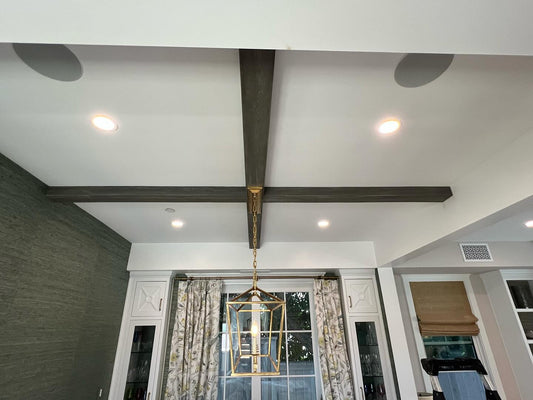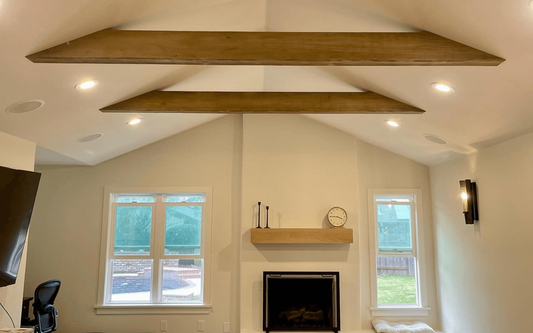
Faux Wood Beams: The Ultimate Design & Installation Guide

Few architectural details transform a room the way ceiling beams do. They add depth, warmth, and instant character — whether you're renovating a 1970s ranch in Elk Grove or finishing a new build in Walnut Creek. The problem? Genuine timber beams are heavy, expensive, and impractical for most residential ceilings. That's where faux wood beams come in. Made from high-density polyurethane or fiberglass-reinforced composites, today's faux beams weigh a fraction of real lumber yet deliver a finish so convincing that even contractors do a double-take. This guide covers every detail — materials, costs, styles, installation, and long-term maintenance — so you can make a confident decision for your project. If you'd like to browse product options before reading further, visit our faux wood beam collection.
What Are Faux Wood Beams?
Faux wood beams are hollow, lightweight replicas of solid timber beams manufactured from advanced composite materials. They're designed to mount directly onto drywall ceilings, wrap around existing structural elements, or span open rooms — all without requiring any structural reinforcement.
Materials & Manufacturing
The two dominant materials in today's market are high-density polyurethane (HDU) and fiberglass-reinforced polymer (FRP). HDU beams start as liquid resin that gets injected into molds cast from actual reclaimed timber. Every knot, crack, saw mark, and grain line from the original wood transfers into the mold, producing surface detail that photographs identically to real lumber. FRP beams use a similar molding process but add chopped fiberglass strands to the resin matrix, producing a beam with even higher impact resistance — useful for commercial spaces or outdoor pergolas.
After molding, each beam receives a multi-layer finishing treatment. Base coats establish the underlying wood tone, and hand-applied glazes create the depth and variation you see in naturally aged timber. Premium manufacturers offer finishes that replicate specific species — white oak, Douglas fir, rough-sawn cedar, hand-hewn barnwood — with accuracy that's hard to distinguish from the real thing at arm's length.
Weight Comparison
Weight is the single biggest advantage faux beams hold over solid wood. A standard 6" × 8" faux beam weighs roughly 1 to 2 pounds per linear foot. The same profile cut from genuine Douglas fir tips the scale at 12 to 20+ pounds per foot, depending on moisture content and species. That difference matters enormously when you're working overhead. A 12-foot faux beam can be lifted into position by one person; a 12-foot solid timber beam requires a crew and mechanical lift. For homeowners in Sacramento and the Bay Area, where many homes sit on older foundations and lightweight roof trusses, faux beams eliminate the need for costly structural engineering just to add a decorative element to the ceiling.
How Realistic Do They Look?
Realism has improved dramatically over the past decade. Early foam beams had a plastic sheen and repetitive grain patterns that gave them away instantly. Current-generation HDU beams are virtually indistinguishable from wood when viewed from normal room distance (6–10 feet below the ceiling). The texture is three-dimensional — you can feel grain ridges, knot depressions, and saw-cut grooves with your fingers. When stained or painted by a finishing specialist, the result is a surface that even woodworkers struggle to identify as synthetic without touching it directly. At Elite Ceiling Designs, we hand-finish every beam to match the client's interior palette, so the end product looks like it grew with the house.
Faux vs. Real Wood Beams — A Detailed Comparison
Choosing between faux and real wood comes down to budget, structural capacity, and how much ongoing maintenance you're willing to accept. Here's a thorough breakdown of each factor.
Cost
Faux beams typically run between $15 and $45 per linear foot for the beam itself, depending on profile size and finish complexity. A 20-foot great room with four 20-foot beams lands in the $1,200–$3,600 range for materials. Real solid wood beams — especially kiln-dried hardwood or hand-hewn reclaimed timber — range from $50 to $150+ per linear foot. That same four-beam room can run $4,000 to $12,000 or more in wood alone, before you factor in the added labor and structural modifications needed to support the weight.
Weight & Structural Requirements
As mentioned, faux beams weigh 1–2 lbs/ft versus 10–20+ lbs/ft for real wood. Most residential ceilings can support faux beams with nothing more than standard mounting blocks screwed into joists. Solid timber beams often require steel brackets, reinforced joists, or even new header beams to carry the load safely. In older Sacramento homes — particularly those built before the 1990s with lighter truss systems — the structural upgrade cost alone can exceed the price of the beams themselves.
Installation Difficulty
A skilled two-person crew can install faux beams in a standard room in one to two days. Real wood beam installation typically takes two to four days and demands heavier equipment: come-alongs, chain hoists, or even a small crane for beams over 16 feet. That translates to higher labor cost and more disruption to your household.
Maintenance
Faux beams need almost zero maintenance. They don't split, warp, crack, or attract termites. An occasional wipe-down with a damp cloth is all that's required. Real wood beams, particularly in rooms with temperature swings or humidity shifts, can develop checking (small surface cracks), seasonal movement, and may require periodic refinishing to stay looking their best.
Moisture & Pest Resistance
Polyurethane and fiberglass are inherently waterproof and inedible to insects. That makes faux beams ideal for kitchens, bathrooms, covered patios, and pool houses — environments where solid wood is prone to swelling, mold, or pest damage. In the Bay Area's coastal humidity zones and Sacramento's hot-dry summers, faux beams maintain dimensional stability year-round.
Fire Rating
Many HDU faux beams carry a Class A or Class B fire rating when tested to ASTM E84 standards, meaning they have a flame-spread index comparable to or better than untreated softwood lumber. Some commercial-grade FRP beams meet Class A requirements out of the box, which simplifies code compliance for restaurant, hotel, and retail projects.
Customization
Both faux and real wood can be stained, painted, or distressed. Faux beams have a slight edge in consistency — every beam from the same mold has identical grain patterns and dimensions, making it easy to achieve uniform spacing across a large ceiling. Real wood beams, by contrast, have natural variation (which some homeowners prefer for character).
Types of Faux Beams
Faux beams come in several profiles, each suited to different applications. Here's a breakdown of the most common types available through Elite Ceiling Designs.
Box Beams
Box beams are the most popular faux beam style and the one most people picture when they hear "ceiling beams." They're three-sided hollow shells — typically U-shaped or L-shaped in cross-section — designed to mount flat against a ceiling or wrap around an existing structural beam, post, or duct chase. Standard profiles range from 4" × 4" for subtle accent work up to 12" × 16" for dramatic vaulted-ceiling installations. The hollow core keeps weight minimal and also provides a convenient channel for running electrical wiring, recessed lighting leads, or speaker cables out of sight.
Mantels
Faux wood mantels use the same polyurethane construction as ceiling beams but are designed specifically for fireplace surrounds. They mount to the wall above the firebox, providing the look of a solid timber mantel shelf at a fraction of the weight. This matters because many modern zero-clearance fireplaces have weight limits on what can be mounted above them. A faux mantel in a rough-hewn barnwood finish can weigh under 10 pounds total for a 5-foot span — light enough to mount with standard masonry anchors.
Planks
Faux wood planks are thin, flat panels — usually ½" to 1" thick — that cover entire ceiling or wall surfaces. Think of them as the beam equivalent of shiplap: they create a continuous wood-look surface without the moisture sensitivity of real wood tongue-and-groove planking. Planks work especially well in kitchens and bathrooms where steam and cooking grease would damage genuine wood over time. They install quickly with construction adhesive and a few brad nails, and they can be cut with standard woodworking tools.
I-Beams
I-beams borrow their shape from structural steel: a vertical web flanked by horizontal flanges on top and bottom. In faux wood, they deliver an industrial or modern-farmhouse aesthetic that pairs well with exposed brick, polished concrete, and metal fixtures. These are growing in popularity in Sacramento's midtown lofts and converted warehouse spaces. The I-beam profile is slightly more complex to install than a standard box beam, but the visual payoff is worth the effort for modern and transitional interiors.
Logs
Faux log beams are full-round or half-round profiles that mimic peeled or bark-on timber logs. They're the go-to choice for rustic cabins, mountain retreats, and lodge-style great rooms. A half-round log beam mounts flat against the ceiling and weighs roughly 2–3 pounds per linear foot — a fraction of even a small-diameter real log, which can easily weigh 30+ pounds per foot. For homeowners in the Tahoe-to-Sacramento corridor who want that cabin feel without the structural commitment, faux logs are a practical solution.
Design Styles for Faux Wood Beams
One of the biggest advantages of faux beams is design flexibility. Because they can be finished in virtually any color, texture, and sheen, they adapt to a wide range of interior styles. Our architectural design team can help you select the right profile and finish for your space.
Rustic & Farmhouse
This is the style most associated with exposed ceiling beams. Think hand-hewn textures with visible adze marks, deep knots, and a weathered dark-walnut or espresso stain. Beams are usually oversized (8" × 10" or larger) and spaced 3–4 feet apart across a flat or gently vaulted ceiling. The heavy visual weight of the beams anchors the room and creates an intimate, grounded feeling even in large open-plan spaces. Pair with wide-plank hardwood floors, iron light fixtures, and natural stone for a cohesive farmhouse look.
Modern Farmhouse
Modern farmhouse lightens the palette while keeping the organic texture. Beams are finished in lighter tones — driftwood gray, whitewashed oak, or natural pine — with cleaner, more uniform grain patterns. The profile may be slightly smaller (6" × 6" to 6" × 8"), and spacing is often wider to keep the ceiling feeling open and airy. This style has exploded across Sacramento's Natomas and Folsom subdivisions, where new-build homes with 9-foot ceilings use faux beams to add personality without overwhelming the room.
Mediterranean & Tuscan
Mediterranean interiors call for warm, amber-toned beams that echo terra cotta tile, stucco walls, and wrought-iron details. The finish typically mimics aged European chestnut or walnut, with a slightly smoother surface than a rustic beam but still plenty of visible grain. Beams are often arranged in a grid or coffered pattern, sometimes combined with decorative corbels at the wall junction. Sacramento's Arden Park and Fair Oaks neighborhoods have a number of Mediterranean-revival homes where faux beams are a natural upgrade to the existing ceiling.
Contemporary & Minimalist
Contemporary design strips the beam concept down to its geometric essentials. Beams have a smooth, sanded finish with minimal grain texture — almost like laminated engineered lumber. Colors lean toward black, charcoal, or pale ash. The arrangement tends to be deliberate and architectural: evenly spaced parallel lines, a single dramatic ridge beam, or an asymmetric cluster that functions as a sculptural element. This style works particularly well in Bay Area modern homes with floor-to-ceiling glass, where the beams frame views without competing with them.
Craftsman
Craftsman-style homes — common across the Bay Area's older neighborhoods — traditionally feature quarter-sawn white oak trim with a warm honey or amber tone. Faux beams in a Craftsman context replicate that same quartersawn ray-fleck pattern, usually in a 6" × 8" or 8" × 8" box beam profile. They're arranged in a simple parallel grid that emphasizes the room's proportions. For authenticity, the beams should terminate into matching faux corbels or beam straps at the wall line.
Vaulted Ceiling Beam Applications
Vaulted and cathedral ceilings are where faux beams shine brightest. The sheer height amplifies the visual drama, and the lightweight material avoids the engineering headaches that come with hanging real timber 15–20 feet overhead. Here are the key design and practical considerations — and you can see finished projects in our project gallery.
Spacing Patterns
For most vaulted ceilings, beams are spaced evenly between the ridge line and the eave. A common formula: 8"–12" wide beams set 36"–48" on center. In a room with a 20-foot span from wall to wall, that typically works out to four or five beams per side. Wider spacing creates a more open, contemporary feel; tighter spacing gives a heavier, more traditional impression. The optimal ratio depends on ceiling height — higher vaults can handle more beams without feeling cluttered.
Ridge Beams vs. Cross Beams
A ridge beam runs along the peak of the vault from one gable end to the other. It acts as a strong visual centerline and is often the largest beam in the installation — 10" × 12" is a common choice. Cross beams (also called tie beams or collar beams) run perpendicular to the ridge, spanning from one slope to the other. They create the classic timber-frame look. You can use one approach or combine both for a full framework effect. On faux beam installations, the ridge beam is usually installed first, and cross beams are butted into it with pre-cut mitered joints.
Cathedral Ceiling Considerations
Cathedral ceilings — where the ceiling follows the roofline all the way to the ridge without a flat section — present a unique challenge: every beam sits at an angle, and the joints at the ridge need precise miter cuts. With faux beams, this is manageable because the lightweight material can be cut with a standard miter saw. A good installer templates the angles on-site, cuts each beam to fit, and uses color-matched caulk at the joints for a seamless appearance. The result is far easier to achieve than it would be with 200-pound solid timbers suspended at odd angles.
Structural Considerations
Even though faux beams are decorative, the mounting hardware needs to be solid. Each beam mounts over a series of wooden mounting blocks (typically 2×4 or 2×6 lumber) that are lag-screwed into ceiling joists or rafters. On a vaulted ceiling, it's critical to locate every rafter accurately — a stud finder and a test probe are essential. In Sacramento-area homes built with truss roofs, the truss bottom chord may not be accessible at every point along the vault, so mounting block placement requires careful planning.
Color Matching & Finishing
Off-the-shelf faux beams come in a range of standard wood tones — dark walnut, honey oak, weathered gray, espresso, and natural pine are the most common. But standard colors rarely align perfectly with the flooring, cabinetry, and trim already in your home. That's why Elite Ceiling Designs offers custom color-matching and stain services for every beam installation we handle.
The Color-Matching Process
Our team takes samples of your existing wood tones — a cabinet door, a flooring plank, a furniture piece — and develops a custom stain formula in our finishing shop. We build up the color in layers: a base tone that matches the dominant hue, a grain-highlight glaze that adds depth, and a topcoat that controls sheen (matte, satin, or semi-gloss). Each layer is applied by hand, which is what separates a professional finish from a factory spray job. The final result integrates seamlessly with your existing palette.
Restaining & Refinishing
One of the overlooked benefits of faux beams is that they can be refinished. If you change your interior color scheme five years from now, your beams don't have to stay locked into the original stain. A light sanding of the topcoat followed by a new stain application gives you a completely fresh look. This kind of flexibility isn't always possible with real wood beams, which may have penetrating oil finishes that are difficult to strip evenly.
Installation Process
Understanding how faux beams are installed helps set expectations around timeline, disruption, and cost. Elite Ceiling Designs handles every step, from layout planning to final touch-up. Learn more about our installation services.
Step 1: Layout & Measurement
Before any material arrives on-site, we map the ceiling. That means measuring the room dimensions, locating joist or rafter positions, noting any obstacles (light fixtures, HVAC registers, ceiling fans), and calculating beam spacing. For vaulted ceilings, we template the angles using a digital angle finder to ensure precise miter cuts. This planning phase takes 30–60 minutes for a standard room and prevents expensive mistakes during installation.
Step 2: Mounting Block Installation
Mounting blocks are the backbone of every faux beam installation. These are short lengths of dimensional lumber — usually 2×4 for beams under 8" wide, or 2×6 for larger profiles — cut to fit snugly inside the hollow beam channel. Each block is lag-screwed directly into a ceiling joist with 3"–4" structural screws. We place mounting blocks every 3–4 feet along the beam run, plus one at each end. For heavier beams or longer spans, we reduce the spacing to every 24 inches.
Step 3: Beam Fitting & Attachment
With the mounting blocks in place, the beam slides over them like a sleeve. We apply a bead of construction adhesive (polyurethane-based, not latex) along the top inside edges of the beam, then press it up against the ceiling and drive trim-head screws through the beam walls into the mounting blocks. The screw holes are tiny — about the diameter of a finish nail — and get filled with color-matched putty. From the ground, they're invisible.
Step 4: Joints & Corners
Most faux beams come in lengths of 8–20 feet. Rooms longer than the beam stock require a butt joint where two beams meet end-to-end. We hide these joints with a decorative beam strap (a faux iron or leather band that wraps the beam) or by placing the joint inside a perpendicular cross-beam intersection. For L-shaped or coffered layouts, corner joints are mitered at 45 degrees and bonded with adhesive, then touched up with matching stain to create a seamless transition.
Step 5: Final Touch-Up
After all beams are mounted, we do a final walk-through. Screw holes get filled, any adhesive squeeze-out is cleaned, and joint lines receive a last coat of color-matched stain. The entire ceiling-to-beam junction is caulked with a paintable silicone that prevents visible gaps as the house settles.
Timeline
For a typical living room or great room with 4–6 beams on a flat ceiling, installation takes one full day. Vaulted ceilings with ridge and cross beams generally require two days. Larger projects — full-home installations or commercial spaces — are scoped individually, but most residential jobs are completed within a week.
Indoor vs. Outdoor Applications
Faux beams aren't limited to interior ceilings. Outdoor living spaces — covered patios, pergolas, porch ceilings, and pool cabanas — are some of the fastest-growing applications, particularly in Sacramento's climate where outdoor entertaining runs nearly year-round.
Outdoor-Rated Materials
Not all faux beams are suitable for outdoor use. Look for beams specifically rated for exterior exposure, with UV-stabilized polyurethane and a sealed, non-porous surface. UV stabilizers prevent the color from fading in direct sunlight — a critical consideration in Sacramento, where summer temperatures routinely hit 100°F+ and UV index values are among the highest in California. Without UV protection, an exterior beam can fade noticeably within a single season.
Patio & Pergola Applications
Covered patios are the most common outdoor application. Faux beams mount to the patio ceiling using the same mounting-block method as interior installations, with one addition: all fasteners should be stainless steel or hot-dipped galvanized to prevent corrosion. For open pergolas — where the beams are exposed to rain and direct sun on all sides — we recommend FRP (fiberglass-reinforced) beams over standard HDU, as FRP has superior moisture and UV resistance. Visit our residential project gallery to see examples of outdoor beam installations across the Sacramento and Bay Area regions.
Sacramento & Bay Area Climate Considerations
Northern California's climate creates a unique set of conditions for outdoor materials. Sacramento's Central Valley summers are hot and dry (100°F+ days from June through September), while winters bring moderate rain and occasional frost. The Bay Area adds coastal fog, salt air, and higher ambient humidity. Faux beams handle both environments well because they don't absorb moisture, expand, or contract with temperature swings. Real wood beams in outdoor Sacramento applications tend to crack and check within a few years as they cycle through extreme wet-dry and hot-cold swings. Faux beams, by contrast, remain dimensionally stable decade after decade.
Pool Houses & Wet Environments
Pool cabanas, outdoor kitchens, and covered spa areas subject ceiling materials to constant humidity, chlorine off-gassing, and water splashes. Polyurethane faux beams are impervious to all three. They won't grow mold, won't delaminate, and won't rot — problems that plague real wood in these environments. For commercial pool facilities, faux beams also meet health-code requirements more easily because their non-porous surface can be sanitized.
Frequently Asked Questions
How much weight can a ceiling support for faux beams?
Most standard residential ceilings — built with 2×6 or 2×8 joists spaced 16" on center — can easily support faux beam installations without any modification. A typical 8-foot faux beam weighs between 8 and 16 pounds, and that load is distributed across multiple mounting blocks anchored into joists. For reference, a single ceiling joist can support 50+ pounds of dead load at a single point. The total weight of a full-room faux beam layout (4–6 beams) rarely exceeds 75–100 pounds — well within the capacity of any code-compliant ceiling framing.
Can you install faux beams over a textured ceiling?
Yes. Faux beams mount over popcorn, knockdown, orange peel, and smooth ceilings equally well. The mounting blocks create a flat, solid surface for the beam to attach to, and the beam edges sit flush against the ceiling regardless of texture. In fact, installing faux beams over a popcorn ceiling is a popular way to add character without going through the mess and expense of scraping the texture off.
Do faux beams look fake?
High-quality faux beams — the kind we install at Elite Ceiling Designs — are molded from real wood originals with three-dimensional grain, knots, and surface imperfections baked into the material. Once stained and installed at ceiling height, they're genuinely difficult to distinguish from solid timber. The key factors that separate convincing from unconvincing beams are finish quality (hand-stained vs. factory-sprayed), joint treatment, and proper proportioning for the room. Cheap, mass-produced foam beams with flat printed grain can look artificial. Professional-grade HDU beams with custom finishing do not.
How long do faux beams last outdoors?
UV-stabilized polyurethane and FRP beams are rated for 20+ years of outdoor exposure in covered applications (patios, pergolas with roofing). In fully exposed applications — direct sun, direct rain — expect 10–15 years before any noticeable color fading, and even then, the structural integrity of the beam remains sound. A fresh coat of exterior-grade stain can restore the original color without replacing the beam. By comparison, untreated real wood beams in Sacramento's climate often show significant checking and graying within 3–5 years.
Can you paint or restain faux beams after installation?
Absolutely. Faux beams accept paint and stain the same way primed wood does. For a color change, lightly sand the existing finish with 150-grit sandpaper, apply a bonding primer, and then apply your new stain or paint. For minor touch-ups — scuff marks, nicks from moving furniture — a small brush and matching stain is all you need. This repaintability means your beams can evolve with your décor over the years.
What does faux beam installation cost?
Total installed cost — including beams, mounting hardware, and labor — typically ranges from $35 to $75 per linear foot for residential projects. A standard living room with four 15-foot beams (60 linear feet total) usually falls between $2,100 and $4,500 all-in. Vaulted ceilings, custom color matching, and complex layouts (coffered ceilings, multi-directional patterns) push costs toward the higher end. Commercial projects are quoted individually based on scope. For an accurate estimate tailored to your space, request a quote from Elite Ceiling Designs.
Transform Your Space with Faux Wood Beams
Faux wood beams offer the warmth and character of solid timber without the weight, cost, or maintenance. Whether you're envisioning a rustic farmhouse kitchen, a dramatic vaulted great room, or a sleek contemporary living space, there's a beam profile, finish, and layout that fits. At Elite Ceiling Designs, we've installed thousands of linear feet of faux beams across Sacramento, the Bay Area, and Northern California — in homes, restaurants, wineries, hotels, and commercial spaces of every size. Every project starts with an in-home consultation ($200, credited toward your order) where we discuss your vision, measure your space, and provide a detailed quote. Browse our full faux wood beam collection to explore profiles and finishes, or contact us to get started.
The right ceiling design can completely change the look and feel of your space while adding long-term style and value to your home or business.
Ready to transform your ceiling? You can contact Elite Ceiling Designs for a consultation and get a custom solution designed for your space and style.