15 Stunning Coffered Ceiling Ideas That Add Instant Luxury
Coffered ceilings have graced the interiors of grand homes for centuries, and their appeal shows no sign of fading. The structured grid of recessed panels framed by beams creates depth, shadow lines, and architectural interest that flat drywall simply cannot match. Whether your home sits in a quiet Sacramento suburb or a San Francisco Victorian row house, a well-designed coffered ceiling raises the perceived value—and the visual impact—of any room it occupies.
This guide covers 15 distinct coffered ceiling approaches, from traditional all-white painted wood to contemporary hybrid designs that incorporate stretch ceiling technology and other modern ceiling ideas. Each idea includes details on materials, scale, cost considerations, and the specific rooms where the design works best. Browse the full list, bookmark the ideas that resonate with your home's style, and reach out to our team when you are ready to bring one of these concepts to life.
1. Classic White-on-White Coffered Ceiling
A monochromatic white coffered ceiling is the gold standard for traditional and transitional homes. The beams and recessed panels share the same crisp white paint—typically a semi-gloss or satin finish—so the entire design reads through shadow and depth alone rather than color contrast. This look works in rooms with 9-foot ceilings or higher; on lower ceilings, keep beam depth to 3–4 inches to avoid a heavy feel. Crown molding where the beams meet each ceiling panel adds another layer of refinement without increasing the visual weight. Residential ceiling installations in Sacramento frequently start with this timeless approach because it complements almost any décor palette and never goes out of style. Expect material and labor costs for a 12 × 14-foot room to range from $3,000 to $7,000 depending on beam profile complexity.
2. Dark Stained Wood Coffered Ceiling
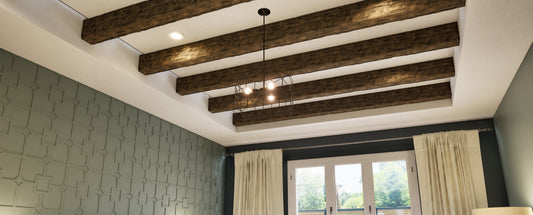
Rich walnut, espresso, or mahogany stains transform coffered beams into a statement feature that anchors the room with warmth and gravitas. Genuine hardwood delivers the deepest color and grain character, but high-density polyurethane faux wood beams achieve a nearly identical look at a fraction of the weight—critical for older homes where ceiling joists may not support solid timber. Pair dark-stained coffers with lighter walls and furnishings to maintain contrast without closing the room in. This style works especially well in studies, formal dining rooms, and living rooms with 10-foot-plus ceilings where the dark tones add intimacy rather than claustrophobia. Expect material costs for a 12 × 14-foot grid to range from $2,500 to $5,500 depending on species and beam depth selected.
3. Two-Tone Painted Coffered Ceiling
Painting beams bright white while filling recessed panels with navy, charcoal, sage green, or even a dusty rose creates dramatic contrast that reads as bespoke millwork. Benjamin Moore Hale Navy (HC-154) and Sherwin-Williams Iron Ore (SW 7069) are perennial favorites for the recessed field among Bay Area designers. The key to a clean result is sharp caulk lines and using a mini foam roller on panel interiors to avoid brush marks. Two-tone coffers add a designer-caliber punch to dining rooms and home offices alike, and they pair beautifully with stretch ceiling panels in the recesses for a perfectly smooth finish that eliminates the risk of drywall cracks over time. Budget roughly $500–$1,200 extra over a single-color coffer for the additional prep and precision painting required.
4. Coffered Ceiling with Stretch Ceiling Panels in the Recesses
This hybrid approach replaces drywall or MDF panels between beams with stretch ceiling membranes, delivering a flawlessly smooth, crack-free surface in every recess. The PVC or fabric membrane can be matte, satin, glossy, printed, or even backlit—opening design possibilities that traditional coffers simply cannot match. Installation involves attaching aluminum track to the inner edges of each beam bay and heat-stretching the membrane into place within minutes. Bay Area homeowners increasingly request this option because it eliminates the need for taping and mudding between beams, cuts overall installation time by roughly 30 percent compared to drywall finishing, and allows easy future access to wiring or ductwork above the membrane. Each bay can be a different color or finish, enabling creative effects like alternating matte and glossy panels.
5. Shallow Modern Coffered Ceiling
Not every coffered ceiling needs deep, ornate beams. A 2-to-3-inch projection from the ceiling plane is enough to define the grid while preserving a streamlined, contemporary profile. Builders achieve this with applied MDF strips or slim polyurethane beams fastened directly to the drywall surface. The shallow depth suits standard 8-foot ceilings and modern open-concept layouts where heavy trim would feel out of place and obstruct sight lines. Finished in flat white, the effect is clean geometry—architectural interest without visual weight or the formality of deeper coffers. Browse design examples in the project gallery to see shallow coffers in real Sacramento-area homes. This is one of the most cost-effective coffered options, typically running $1,800–$3,500 for a 12 × 14-foot room including installation.
6. Rustic Hand-Hewn Beam Coffered Ceiling
For farmhouse, mountain, or Craftsman-style homes, hand-hewn coffers deliver texture that milled lumber cannot replicate. The irregular adze marks, saw kerfs, and natural checking tell a story of age and craft that resonates in rooms with stone fireplaces and wide-plank flooring. Authentic reclaimed timbers carry this character naturally, but lightweight faux wood beams molded from real timber masters recreate every imperfection at roughly 90 percent less weight—making them practical even for homes without reinforced ceiling framing. Arrange beams in a simple 3 × 3 or 4 × 4 grid with visible corbels at the perimeter where beams meet the wall for added structural drama. Stain choices in the chestnut-to-dark-walnut range emphasize the rustic character, while a light gray wash gives the beams a more weathered, coastal feel.
7. Coffered Ceiling with Integrated LED Lighting
Embedding LED strip lights along the inner edges of each beam—either on all four sides of the recess or just the perimeter—turns a coffered ceiling into a stunning ambient light source. Warm-white LEDs (2700 K–3000 K) tucked behind a small lip or aluminum channel cast a soft upward glow onto each recessed panel, creating a floating effect after dark that transforms the room's atmosphere. Dimmable drivers let you transition from functional brightness during the day to a relaxed mood at night with a single slider. Combined with stretch ceiling installations that diffuse light evenly across the panel surface, this technique produces a luminous grid that can replace the need for multiple recessed can lights. Factor in roughly $800–$1,500 for LED materials and drivers on top of standard coffer construction costs.
8. Large-Scale Coffered Ceiling for Great Rooms
Great rooms with 12-foot-plus ceilings and open floor plans demand coffers scaled proportionally. Beams 8–10 inches deep and panels 3 to 4 feet across establish proportions that read clearly from every corner of the room, even 20 feet away. Using fewer, larger bays prevents the grid from looking busy at height and keeps the design dignified rather than cluttered. Residential ceiling projects in Northern California's newer construction often feature these grand-scale coffers stained in warm oak or painted to match the home's trim package. A single large coffered ceiling can unify a combined living-dining-kitchen space by providing a visual canopy over the main seating area, subtly defining the zone without walls or room dividers.
9. Octagonal and Hexagonal Coffered Ceiling
Breaking away from the standard rectangular grid, octagonal or hexagonal coffers introduce a geometric pattern that feels fresh, unexpected, and artistically layered. This layout traces its roots to Renaissance and Moorish architecture but translates surprisingly well into contemporary interiors when executed with clean lines and minimal molding. The joinery is more complex than rectilinear coffers—each intersection involves angled cuts rather than simple 90-degree joints—so precise CNC fabrication matters. Elite Ceiling Designs uses computer-routed components to ensure tight-fitting angles on every panel. The effect is particularly striking in two-story entryways, rotundas, formal dining rooms, and round or octagonal rooms where the ceiling is a natural focal point that guests notice immediately upon entering the space.
10. Coffered Dining Room Ceiling
The dining room is arguably the best room in the house for a coffered ceiling. Guests spend long stretches seated at the table, and their eyes naturally travel upward during conversation pauses. A centered coffer grid aligned with the table footprint—typically 8 × 10 or 10 × 12 feet—frames the chandelier and anchors the room's symmetry. Beam depth of 5–6 inches and a decorative crown detail at each intersection elevate the formality and justify a more elaborate fixture overhead. Consider contrasting the center panel with a medallion or a printed stretch ceiling insert depicting a subtle damask or geometric pattern to draw the eye upward. Dining-room coffers also improve acoustics by breaking up sound reflections, making conversation clearer and reducing that echo-chamber effect common in hard-surfaced formal rooms.
11. Coffered Ceiling with Wallpaper in Recesses
Applying wallpaper or peel-and-stick wall covering to the recessed panels between beams is a high-impact, low-cost way to personalize a coffered ceiling with pattern and color. Geometric prints, subtle damask, metallic grasscloth, or botanical motifs each create a distinctly different mood. Because the panels are small—often 18 × 18 to 30 × 30 inches—you need very little material, and alignment errors are far less noticeable than on a full wall surface. White-painted beams framing patterned panels produce a gallery-like effect that showcases each panel as an individual art piece. This technique works especially well in powder rooms, nurseries, and residential bedrooms where a whimsical or decorative touch is welcome. Swapping the wallpaper later for a seasonal or style refresh costs under $200 in materials.
12. Coffered Bedroom Ceiling with Cove Lighting
Bedrooms benefit from soft, indirect light, and a coffered ceiling with cove lighting delivers exactly that kind of gentle illumination. A recessed channel around the outer perimeter of the coffer grid houses LED tape that washes the ceiling with a warm glow, eliminating the need for a central fixture that shines directly into your eyes when you are lying in bed. Keep the grid simple—a single large center panel or a 2 × 2 layout—to maintain a calm, uncluttered look overhead that promotes relaxation. Pair the cove-lit coffers with matte or satin stretch panels in the bays for a seamless, crack-free finish that never needs repainting. A warm color temperature around 2700 K and a dimmer switch create the ideal sleep-friendly ambiance.
13. Coffered Library or Home Office Ceiling
Libraries and home offices thrive on a sense of gravitas, and a coffered ceiling reinforces the feeling of an established, serious space where focused work happens naturally. Medium-toned stained beams—think cherry or pecan—coordinate with built-in bookshelves and wainscoting to produce a cohesive millwork envelope that wraps the room in warmth and craftsmanship. Recessed panels painted a shade darker than the walls (try Benjamin Moore Revere Pewter shifted one step deeper) add subtle depth without competing with the shelving or artwork. Integrating adjustable downlights within each bay lets you aim light precisely at the desk or reading chair for task illumination that supplements ambient lighting. Explore faux beam options that replicate stained hardwood without the six-to-eight-week lead time and premium cost of custom solid-wood milling.
14. Gold Accent Coffered Ceiling
A touch of gold—applied as a thin accent line where beams meet panels, or as a gilded rosette at each intersection—turns a coffered ceiling into a showpiece worthy of a designer portfolio. The gold does not need to be overwhelming; a 1/4-inch leaf stripe or metallic paint detail is enough to catch light and convey opulence. This approach suits formal living rooms, dining rooms, and master bathrooms where a luxury finish is both appropriate and expected. Warm metallics pair well with cream, ivory, or deep jewel-tone walls such as emerald or sapphire blue. For the smoothest recessed panels to catch that reflected gold shimmer, consider glossy stretch ceiling inserts in each bay—the reflective surface amplifies the metallic accent and multiplies the effect beautifully.
15. Transitional Coffered Ceiling with Mixed Materials
Transitional design bridges traditional craftsmanship and contemporary simplicity, and a mixed-material coffered ceiling embodies that philosophy on the fifth wall. Combine painted MDF beams with natural wood inlay strips along the beam face, or alternate between stained and painted bays in a checkerboard pattern that introduces rhythm and visual texture. Some designers mix faux wood beams for the main grid with sleek plaster or polyurethane molding for the panel borders, creating a ceiling that feels layered and curated rather than one-dimensional. The trick is limiting the palette to two complementary materials; adding a third risks visual clutter. This versatile approach adapts to great rooms, kitchens, and entryways across Sacramento and the Bay Area, and it often becomes the conversation-starting detail that ties an entire room's design scheme together.
Our Top Picks
If you are narrowing the field, here are our three most-requested coffered ceiling designs at Elite Ceiling Designs based on hundreds of completed projects across Northern California:
- Best for most homes: Classic White-on-White Coffered Ceiling — timeless, universally flattering, and works with nearly every interior style from traditional to modern farmhouse.
- Best for modern impact: Coffered Ceiling with Stretch Ceiling Panels — flawless panel surfaces, multiple finish and color options, simplified installation, and zero cracking over time.
- Best for warmth and character: Rustic Hand-Hewn Beam Coffers — perfect for farmhouse, mountain, and Craftsman interiors throughout Northern California's diverse housing stock.
No matter which style appeals to you, the right coffered ceiling transforms a room from ordinary to architecturally distinctive. Reach out to discuss your project dimensions, ceiling height, and style preferences, and we will provide a detailed proposal with material options and a realistic timeline.