Can You Install Faux Beams on a Flat Ceiling? Yes - Here's How

Key Takeaways
- Faux beams install on flat ceilings just as easily -- often more easily -- than on vaulted ones.
- Standard 8-foot ceilings work with beams sized 4"x6" or smaller; 9-foot ceilings open up 6"x8" options.
- Mounting requires locating ceiling joists or adding blocking -- adhesive alone is not enough for safe installation.
- Pattern choice (parallel, grid, perimeter, single statement) changes the visual effect dramatically.
- Drywall ceilings are simpler to work with than plaster; both are fully compatible with faux beam installation.
One of the most common questions we hear from homeowners across Sacramento and the Bay Area: "My ceilings are flat -- can I still get the beam look?" The answer is an emphatic yes. Flat ceilings are actually the most common surface we install faux beams on, and the results consistently impress. If you have been browsing our complete guide to faux wood beams and wondering whether your standard-height ceiling qualifies, this article breaks down exactly what is involved -- from pattern selection to the mechanical details of mounting.
The misconception that decorative beams belong only on vaulted or cathedral ceilings probably comes from real-wood timber framing, where exposed structural beams follow the roofline. Faux beams are a different product entirely. They are hollow, lightweight (typically 1 to 3 pounds per linear foot), and designed to mount flush against any flat surface. The majority of homes in the Sacramento metro and surrounding areas -- Elk Grove, Roseville, Folsom, Rancho Cordova -- have flat ceilings between 8 and 9 feet. These are ideal candidates.
Beam Patterns That Work on Flat Ceilings
Choosing a layout is the first and most impactful decision. The pattern dictates how the room feels -- taller, wider, cozier, or more dramatic. Here are the four most popular arrangements we install in residential projects.
Parallel Runs
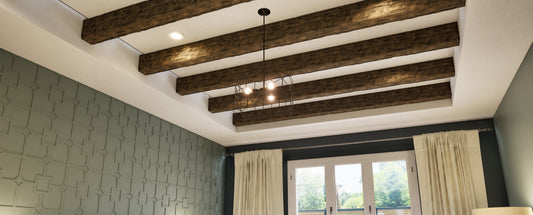
The classic approach: beams running in evenly spaced parallel lines across the ceiling. Spacing depends on room size and beam dimensions, but a good starting point is 3 to 4 feet on center for rooms under 250 square feet, and 4 to 5 feet on center for larger spaces. Parallel beams running the short dimension of a rectangular room make it feel wider; running them along the long dimension creates a sense of depth and draws the eye toward the far wall. In Sacramento ranch-style homes with long, open floor plans, we frequently run beams perpendicular to the main sightline to break up an otherwise monotonous flat plane.
Grid or Coffered Effect
A grid pattern -- beams crossing in both directions to form rectangular panels -- mimics the look of a traditional coffered ceiling at a fraction of the cost and weight. True coffered ceilings require extensive carpentry and can cost $25,000 to $50,000 in wood and labor. A faux beam grid achieves a strikingly similar visual for roughly $4,000 to $10,000 depending on room size and beam profile. The grid works best in formal spaces: dining rooms, home offices, and living rooms where you want an architectural statement. One important note: grids require careful layout planning at the intersections so the joints look seamless.
Single Statement Beam
Not every room needs a pattern. A single large beam running down the center of the ceiling -- typically spanning the longer dimension -- delivers a bold, rustic focal point without visual complexity. This is our most popular option for kitchens with islands; the beam runs directly above the island, often paired with pendant lights mounted through the hollow center. The hollow core of faux beams makes electrical runs straightforward, and we can pre-drill for pendant or recessed light housings before installation.
Perimeter Framing
Beams installed around the perimeter of the ceiling -- essentially an oversized picture frame -- add definition to a room without cluttering the center. This pattern works especially well in bedrooms, where a clean center ceiling allows for a flush-mount light fixture or ceiling fan while the perimeter beams add warmth and dimension. A perimeter frame can also be combined with a single center beam for an elegant, layered look.
How Faux Beams Mount to a Flat Ceiling
Understanding the mounting process removes a lot of the anxiety homeowners feel about putting anything heavy on their ceiling. Faux beams are not heavy -- but they still need to be secured correctly. Here is the standard approach our installation team follows.
Step 1: Locate the Ceiling Joists
Every installation starts with a stud finder. Ceiling joists in most Sacramento-area homes are either 2x6 or 2x8 lumber spaced 16 inches on center (some older homes use 24-inch spacing). We mark every joist location across the planned beam path. For beams running perpendicular to the joists, this is straightforward -- each beam crosses multiple joists and gets fastened at every intersection. For beams running parallel to the joists, we need to either align the beam directly over a joist or add blocking between joists.
Step 2: Install Mounting Blocks
Mounting blocks are small wood cleats -- typically 2x4 or 1x3 lumber -- screwed directly into the ceiling joists. These blocks sit inside the hollow beam and give the beam edges something to grab onto. For a typical 12-foot beam, we install a mounting block every 3 to 4 feet. Each block gets two 3-inch structural screws driven into the joist. This is the backbone of the installation; done correctly, each mounting point can support well over 50 pounds, far exceeding what a 1-to-3-pound-per-foot faux beam requires.
Step 3: Attach the Beam
The faux beam slides over the mounting blocks like a three-sided sleeve. We apply construction adhesive along the contact surfaces and then secure the beam flanges to the blocks with finish screws or brad nails. The screw holes get filled with color-matched wood putty and are essentially invisible once dry. The entire process -- from marking joists to finished beam -- takes roughly 30 to 45 minutes per beam for experienced installers.
A Note on Adhesive-Only Installation
Some online tutorials suggest mounting faux beams with adhesive alone. We strongly advise against this for ceiling applications. Construction adhesive performs well under shear stress (side-to-side) but poorly under tensile stress (pulling away from the surface), which is exactly the force gravity applies to a ceiling-mounted beam. Adhesive is a complement to mechanical fasteners, not a replacement. Every beam we install at Elite Ceiling Designs is mechanically secured to the structure.
Ceiling Height and Beam Sizing: Getting the Proportions Right
This is where flat-ceiling installations require the most careful planning. The beam depth (how far it hangs below the ceiling) directly affects how tall the room feels afterward. Get the proportions wrong, and the beams can make a comfortable room feel cramped.
Here is the sizing framework we use based on ceiling height:
- 8-foot ceilings: Use beams no deeper than 4 to 5 inches. A 4"x6" profile (4 inches deep, 6 inches wide) is ideal. This adds texture and character without noticeably lowering the visual plane. Avoid dark stains on low ceilings -- lighter tones keep the room open.
- 9-foot ceilings: The sweet spot for most beam installations. A 6"x8" beam works beautifully here. You have enough overhead clearance to go with medium-to-dark finishes and still maintain a sense of spaciousness. Most of our Sacramento installations fall in this range.
- 10-foot and higher ceilings: Go bold. Beams sized 8"x10" or larger make a proportional statement. Deeper beams with heavy distressing and dark stains create that dramatic timber-frame aesthetic. At this height, you can also run beams in a tight grid without the room feeling compressed.
A beam that hangs 6 inches below an 8-foot ceiling consumes 6.25% of the total height. That same 6-inch beam on a 10-foot ceiling takes up only 5%. The percentages sound small, but the perceptual difference is significant -- especially when you are standing directly beneath the beam.
Drywall vs. Plaster Ceilings: What Is Different?
Sacramento's housing stock ranges from 1920s bungalows in midtown with original lath-and-plaster ceilings to brand-new construction in Natomas and West Sacramento with standard half-inch drywall. Both surfaces accept faux beams, but the approach differs slightly.
Drywall Ceilings
Drywall is the simpler surface to work with. Stud finders read accurately through it, screws drive cleanly, and the surface is flat and predictable. Half-inch drywall is the standard in residential ceilings; 5/8-inch drywall appears in some fire-rated assemblies and newer construction. Neither thickness changes the installation approach -- the screws pass through the drywall and anchor into the joist above.
Plaster Ceilings
Plaster ceilings require more care. Traditional lath-and-plaster can be 3/4 to 1 inch thick, and the lath strips behind it create false readings on magnetic stud finders. We use deep-scan electronic stud finders and verify with a small pilot hole when working on plaster. Pre-drilling is essential -- driving screws directly into plaster without a pilot hole risks cracking the surrounding surface. We also use slightly longer screws (3.5 inches instead of 3 inches) to account for the added thickness. Despite these extra steps, plaster ceilings hold beams securely once the fasteners are anchored into the joists behind.
How Beams Can Actually Make a Flat Ceiling Look Higher
This is counterintuitive, and homeowners are often skeptical until they see it in person. Adding something to the ceiling -- which technically lowers the lowest point -- can make the overall room feel taller. The trick lies in color contrast and visual layering.
When the ceiling is painted white (or a very light color) and the beams are stained a medium-to-dark tone, the eye perceives the white plane as the "sky" and the beams as separate objects in front of it. This creates a sense of depth -- the white ceiling appears to recede behind the beams, making it feel farther away. Interior designers call this the "layering effect," and it is one of the most reliable visual tricks in residential design.
Spacing also plays a role. Wider gaps between beams let more of that white ceiling show through, reinforcing the perceived height. For an 8-foot ceiling, we typically recommend spacing beams at least 36 inches apart and using a finish at least three shades darker than the ceiling paint. The contrast does the work.
We have documented this effect across dozens of projects in our project gallery. Homeowners frequently tell us their rooms feel bigger after the beams go up -- the opposite of what they expected.
Can Your Ceiling Joists Handle Faux Beams?
Almost certainly, yes. Standard ceiling joists (2x6 or 2x8 at 16 inches on center) are engineered to support a dead load of at least 10 pounds per square foot, plus a live load for attic storage. A typical faux beam installation adds less than 0.5 pounds per square foot to the ceiling load -- a negligible amount.
To put it in perspective: a 6"x8" faux polyurethane beam weighing 2 pounds per linear foot, running 14 feet across a room, adds 28 pounds total. Distributed across the three or four mounting points where it is fastened to joists, each connection point bears about 7 to 9 pounds. A single 3-inch structural screw in a Douglas fir joist has a withdrawal capacity of over 100 pounds. The math is overwhelmingly in your favor.
The only scenario where joist capacity might matter is if you plan to hang heavy chandeliers or pot racks from the beams. Because the beams themselves are hollow, any suspended weight transfers through the mounting blocks to the joists. For loads over 25 pounds, we add reinforced blocking rated for the fixture weight. Our installation team evaluates this during the pre-installation consultation.
Why Sacramento Homes Are Ideal for Flat-Ceiling Beams
Sacramento's residential architecture is dominated by single-story ranch homes and two-story tract homes built between the 1960s and today. The vast majority have flat drywall ceilings at 8 or 9 feet -- exactly the profile where faux beams deliver the biggest visual upgrade for the lowest complexity.
The region's housing boom also means many homes share similar interior finishes: smooth white ceilings, neutral walls, builder-grade fixtures. Adding faux wood beams is one of the fastest ways to differentiate your home interior and add perceived value. Real estate agents in the Sacramento market consistently report that homes with distinctive ceiling treatments photograph better, attract more showing requests, and often appraise higher than comparable properties without them.
If you have been assuming your flat ceiling disqualifies you from the beam look, it does not. Most of our projects -- from Midtown Sacramento to Pleasanton to Walnut Creek -- install on flat ceilings between 8 and 10 feet. It is our most common installation type, and the results speak for themselves.
Ready to see what faux beams would look like in your home? Reach out through our contact page for a consultation. We will assess your ceiling, recommend a beam size and pattern, and provide a detailed quote -- typically within 48 hours.