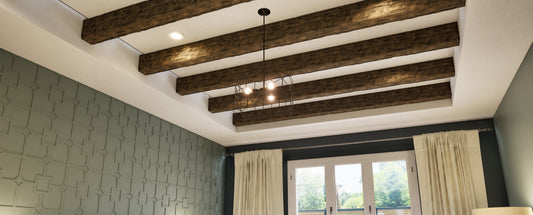
Coffered Ceiling Designs: Classic Elegance for Any Room

Key Takeaways
- Coffered ceilings use a grid of beams to create recessed panels, adding depth, architectural interest, and perceived height to any room.
- Faux beam coffered ceilings cost 40–60% less than traditional carpenter-built versions and install in a fraction of the time.
- Coffer sizing matters: 2×2-foot panels for rooms under 150 sq ft, 3×3 or 4×4 for larger spaces. Proportions make or break the design.
- Modern coffered options include painted faux beams, mixed-material panels with stretch ceiling inserts, and shallow contemporary profiles.
- Best rooms for coffered ceilings: dining rooms, formal living rooms, master bedrooms, and home offices with 9-foot or higher ceilings.
Few ceiling treatments carry as much architectural weight as a coffered ceiling. The recessed grid pattern — beams crossing to form a series of sunken panels — has signaled craftsmanship and refinement for centuries. But coffered ceilings aren't just a relic of formal estates. Modern materials and installation techniques have made this look accessible to far more homeowners, and the design possibilities go well beyond traditional dark wood grids. For a broader look at ceiling treatments across different rooms and styles, see our complete guide to ceiling design ideas for every room.
This guide covers everything you need to know about coffered ceiling design — from the architectural history to the practical decisions around sizing, materials, cost, and room selection. If you've been considering a coffered ceiling for your Sacramento or Bay Area home, this is your planning blueprint.
What Is a Coffered Ceiling?
A coffered ceiling is a series of sunken panels — called coffers — formed by a grid of intersecting beams. The beams project downward from the ceiling plane, and the recessed area between them creates a three-dimensional pattern of squares or rectangles. The depth of the coffers (typically 3 to 8 inches) creates shadow lines that give the ceiling visual texture and architectural depth.
Structurally, coffered ceilings were originally load-bearing — the crossing beams distributed weight across wide spans in stone and masonry buildings. The Pantheon in Rome, built around 125 AD, features one of the most famous coffered ceilings in history: its domed interior uses progressively smaller coffers to reduce the weight of the concrete while creating a stunning visual pattern. During the Renaissance, coffered ceilings became a status symbol in Italian palazzi and churches, often painted or gilded.
In residential construction today, coffered ceilings are purely decorative. The beams are applied to a flat ceiling surface to create the visual effect without structural function. This means the design is limited only by proportion and aesthetics, not engineering constraints.
Faux Beam Coffered Ceilings vs. Traditional Construction
Historically, coffered ceilings required a skilled carpenter or millworker to build the beam grid on-site from solid lumber. The beams were mitered, joined, nailed, filled, sanded, primed, and painted — a labor-intensive process that could take a crew two to three weeks for a single room. Material costs for solid poplar or MDF beams, plus the carpentry labor, put traditional coffered ceilings in the $25 to $45 per square foot range (installed), depending on complexity and your regional labor market.
Modern faux wood beams have fundamentally changed this equation. Faux beams are hollow, lightweight box beams made from high-density polyurethane or composite materials. They replicate the look of solid timber — including realistic wood grain, knots, and hand-hewn textures — at a fraction of the weight. A single faux beam that looks like a 6×6-inch timber might weigh 3 to 5 pounds per linear foot, compared to 12+ pounds for solid wood.
For coffered ceiling applications, faux beams offer several concrete advantages:
- Weight: A full coffered grid in faux beams adds minimal load to the ceiling — critical in older homes where the ceiling joists weren't designed for heavy additions.
- Installation speed: A faux beam coffered ceiling in a 14×16-foot room can be completed in 2 to 3 days versus 10 to 15 days for traditional construction.
- Cost: Faux beam coffered ceilings typically run $12 to $22 per square foot installed — roughly 40 to 60% less than carpenter-built versions.
- Consistency: Factory-manufactured beams deliver uniform profiles and finishes. No warping, no filler joints, no on-site sanding.
Coffered Ceiling Design Variations
Coffered ceilings are far more versatile than the single "dark wood grid" image that comes to mind. Here are the major design directions:
Traditional Deep Coffers
The classic look: 5- to 8-inch-deep beams forming a grid of recessed panels. Beams are typically 4 to 6 inches wide with a profiled (crown molding–style) edge detail where the beam meets the flat ceiling plane. The coffer panels are often flat drywall, sometimes with a rosette or medallion at the center. This version suits Colonial, Craftsman, and traditional-style homes. Paint the beams and panels the same white for a subtle texture play, or stain the beams dark with white panels for maximum contrast.
Shallow Modern Coffers
For contemporary and transitional interiors, a shallow coffered ceiling uses beams that project only 2 to 3 inches from the ceiling. The beam profiles are flat and squared off — no crown molding, no ornamental edges. The result is a clean, geometric grid that adds depth without the visual heaviness of traditional coffers. Shallow coffers work in rooms with 8- to 9-foot ceilings where deeper beams would feel oppressive. Paint everything in a single matte white or light gray for a monochromatic, architectural effect.
Painted Statement Coffers
Rather than relying solely on depth for visual impact, painted coffers use color contrast. The beams remain white or cream, while the recessed panels are painted in a rich, saturated hue — navy blue, deep forest green, charcoal, or even black. The dark panels recede visually, making the coffers appear deeper than they actually are. This is a designer favorite for dining rooms and home offices where a dramatic ceiling adds personality without overwhelming the room.
Mixed-Material Coffers With Stretch Ceiling Panels
This is the option that generates the most excitement in our Sacramento and Bay Area residential projects. Instead of flat drywall or painted panels inside the coffer grid, each recessed panel is fitted with a stretch ceiling membrane. The stretch panels can be backlit for a glowing effect, finished in a glossy lacquer for reflective depth, or printed with a custom pattern or image. The faux wood beam grid provides the structural framework, and the stretch panels become the decorative surface within each coffer. This hybrid approach delivers the dimensional interest of a coffered ceiling with the finish versatility of stretch membrane — a combination that pure drywall construction simply cannot achieve.
Sizing and Proportions: Getting the Grid Right
Coffer sizing is the decision that makes or breaks the design. Coffers that are too small create a busy, cluttered look. Coffers that are too large look incomplete, as if the builders ran out of beams. The goal is a balanced grid that feels proportional to the room.
Guidelines by Room Size
- Small rooms (under 150 sq ft / roughly 10×14 or 12×12): Use 2×2-foot coffers with 3- to 4-inch-wide beams. A 12×12 room fits a clean 5×5 grid (allowing for a border around the perimeter). Smaller coffers suit the scale and avoid overwhelming the space.
- Medium rooms (150–250 sq ft / roughly 12×16 to 14×18): Move to 2.5×2.5 or 3×3-foot coffers with 4- to 5-inch beams. This is the sweet spot for most dining rooms and bedrooms
- Large rooms (250+ sq ft / 16×18 and up): Use 3×3 to 4×4-foot coffers with 5- to 6-inch beams. The larger panels prevent the grid from looking frenetic at this scale.
Beam Depth Relative to Ceiling Height
- 8-foot ceilings: Maximum 3-inch beam depth. Anything deeper eats into headroom and feels low.
- 9-foot ceilings: 3- to 5-inch depth works well. This is the most common scenario in Sacramento-area homes.
- 10-foot and above: 5- to 8-inch depth delivers full visual impact without compromising the sense of height.
Always maintain a flat ceiling border of at least 6 inches (ideally 8–12 inches) between the outermost beams and the walls. This border gives the coffered grid breathing room and avoids the cramped look of beams running directly into the wall-ceiling junction.
Best Rooms for Coffered Ceilings
Coffered ceilings work in more rooms than most homeowners expect, but certain spaces benefit more than others.
Dining Rooms
The single best room for a coffered ceiling. Dining rooms are typically well-proportioned (10×12 to 14×16), used for entertaining, and visible from adjacent living spaces. A coffered ceiling over the dining table elevates the room from functional to formal. The grid pattern also provides a natural framework for a centered chandelier — install it at the intersection of beams or centered within a coffer panel.
Formal Living Rooms and Great Rooms
Living rooms with 9-foot or higher ceilings are strong candidates. In great rooms, coffered ceilings can cover the entire space or be limited to a specific zone (the seating area, for example) to define a room-within-a-room. Pair deep coffers with rich wall colors and substantial furniture for a layered, grounded look.
Master Bedrooms
A coffered ceiling above the bed creates a built-in focal point that eliminates the need for oversized headboard wall art. Consider a shallow coffer (2–3 inches deep) in the bedroom to keep the look warm rather than imposing. Stretch ceiling panels inside the coffers with soft backlight make an especially effective bedroom application — the glow mimics ambient candlelight when dimmed.
Home Offices and Libraries
Coffered ceilings give a home office gravitas. They communicate professionalism on video calls and add the kind of architectural character that makes a dedicated office feel like a real room rather than a converted spare bedroom. Dark-stained beams with cream panels are a classic choice for an office or study. To see examples of coffered ceilings and other beam installations, visit our project gallery.
Installation Process and What to Expect
Whether you're working with a contractor or considering the professional installation process through Elite Ceiling Designs, here's what the typical coffered ceiling project looks like:
- Measurement and layout. The room is measured and the coffered grid is planned on-site. Beam spacing is calculated to create evenly sized panels, accounting for the perimeter border and any obstructions (light fixtures, vents, ceiling fans).
- Support blocking. Nailer blocks or a lightweight furring grid are installed on the existing ceiling to provide secure attachment points for the beams. For faux beams, this step is minimal since the beams are light enough to mount with construction adhesive and screws into the blocking.
- Beam installation. Beams are cut to length, mitered at intersections, and mounted to the ceiling. Cross beams are fitted between the primary runs to complete the grid. Any wiring for recessed lighting within coffers is routed at this stage.
- Finish work. Joints are caulked and touched up. If the beams are paintable, they receive a final coat. Stretch ceiling panels (if used) are installed inside the coffer boxes last, tensioned into aluminum profiles attached to the beam sides.
- Lighting and fixtures. Recessed lights, cove LEDs, or chandeliers are connected and tested. The entire grid is inspected for alignment and finish quality.
For a standard 14×16-foot room with faux beam coffers, expect the project to take 2 to 4 days from start to finish. Mixed-material installations with stretch panels may add 1 to 2 additional days for the membrane work.
Coffered ceilings remain one of the highest-impact ceiling treatments available to homeowners. With faux beam construction making the look more affordable and accessible than ever, there's no reason to settle for a flat, featureless ceiling in your most important rooms. The right coffer design — scaled to your space, matched to your style, and installed by experienced professionals — transforms a ceiling from background to centerpiece.
Planning a coffered ceiling for your Sacramento or Bay Area home? Contact Elite Ceiling Designs for a consultation and custom quote. We'll help you choose the right coffer style, size, and material for your space.