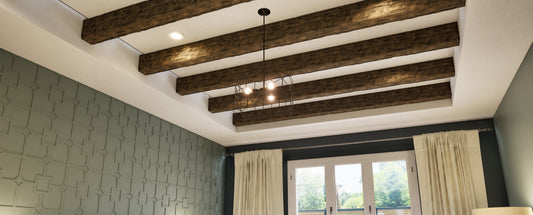
Faux Wood Beams for Vaulted Ceilings: Design Ideas & Layouts
KEY TAKEAWAYS
- Vaulted ceilings are the single best canvas for faux wood beams — the height and angles create dramatic visual impact no flat ceiling can match.
- Five primary layout patterns (parallel cross beams, ridge beam + rafters, king post truss, scissor truss, cathedral peak beam) offer dramatically different looks.
- Beam sizing rule of thumb: beam depth in inches should roughly equal ceiling height in feet at the peak (e.g., 14-ft peak → 12–14 inch beams).
- Lighter finishes (whitewash, gray-wash) keep vaulted spaces feeling open; darker stains (espresso, walnut) add drama and visual warmth.
- Faux beams weigh 1–2 lbs per linear foot — critical for vaulted ceiling installation where structural loading is a major concern with real timber.
A vaulted ceiling is architectural potential waiting to be realized. Without beams, even the most generous cathedral ceiling can feel blank — all that height with nothing for the eye to anchor on. Faux wood beams transform that empty expanse into a structured, intentional design element, and they're uniquely suited to vaulted applications because of their featherweight profile.
Our Faux Wood Beams Ultimate Guide covers materials, costs, and general installation. This article focuses specifically on vaulted ceilings — the layout patterns that work, how to size and space beams for your specific pitch, and finish options that make the design sing.
Why Vaulted Ceilings and Faux Beams Are a Perfect Match
Real timber on a vaulted ceiling amplifies every problem associated with heavy beams. The angled mounting surfaces make structural attachment more complex — gravity wants to pull the beam down the slope, not just straight down, so you need more robust fastening systems. A single 14-foot solid oak beam overhead weighs 250+ pounds, and on a vaulted ceiling, that load creates shear forces on the mounting points that flat-ceiling installations don't face.
Faux beams eliminate these concerns entirely. At 1–2 pounds per linear foot, even the largest faux beam on a steep vault creates negligible structural load. Installation uses the same simple blocking-and-adhesive method as flat ceilings, with angled nailer blocks cut to match the roof pitch. The result looks identical from the floor — and at vaulted ceiling heights of 12–20+ feet, no visitor will ever question authenticity.
Five Layout Patterns for Vaulted Beam Ceilings
1. Parallel Cross Beams
The most straightforward vaulted ceiling beam layout: beams run perpendicular to the ridge line, spanning from one wall plate to the other across the vault. Each beam follows the ceiling slope on both sides, creating a series of arched frames marching down the length of the room.
This pattern works best in long, rectangular rooms — great rooms, master bedrooms, and open-plan kitchen-dining areas. The evenly spaced beams create rhythm and visual order, breaking the expanse into manageable sections without cluttering the peak.
Recommended spacing: 3–4 feet on center for 6–8 inch beams; 4–6 feet for 10–12 inch beams. Tighter spacing creates a more traditional, substantial look. Wider spacing feels more modern and open.
2. Exposed Ridge Beam + Rafters
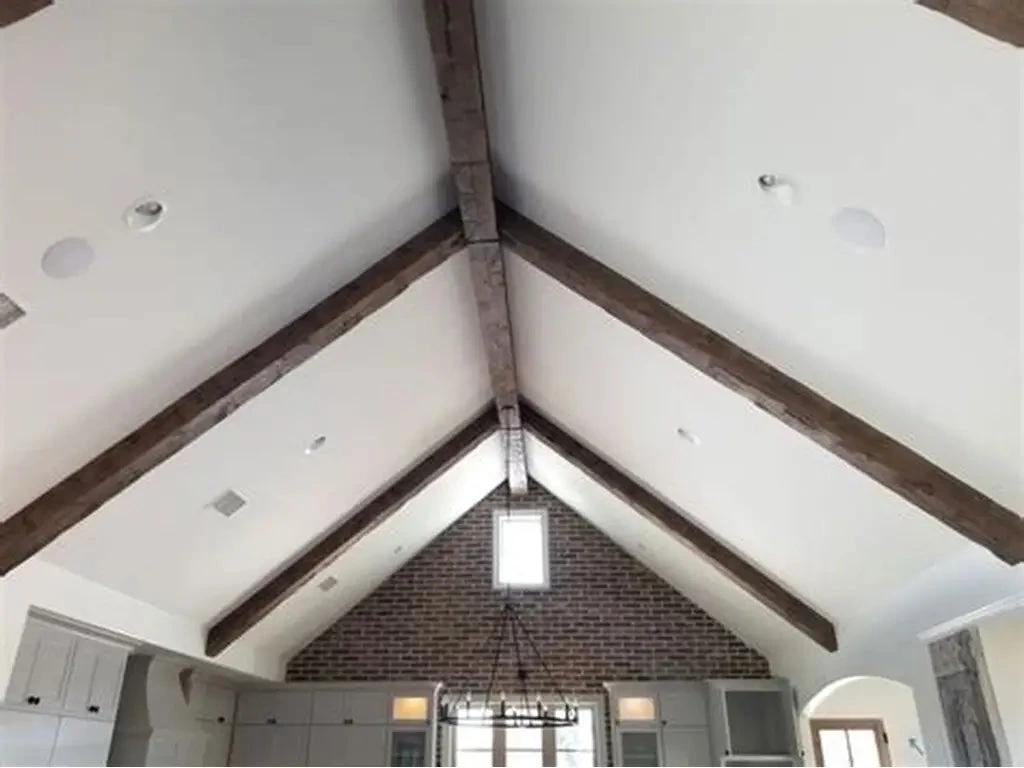
This layout places a single prominent beam running along the ceiling peak (the ridge beam) with smaller rafter-style beams angling down from the ridge to the wall plates on each side. It replicates the look of exposed structural framing — as if you stripped the drywall to reveal the bones of the roof.
The ridge beam should be the largest profile in the room — typically 8×10, 10×10, or 10×12 inches — because it serves as the visual spine. Rafter beams are smaller: 4×6 or 6×6 is typical. The contrast in scale reinforces the structural illusion. This is the most popular vaulted beam layout we install in the Sacramento region, especially in Folsom and El Dorado Hills homes where open great rooms are standard.
3. King Post Truss
A king post truss adds a vertical beam (the king post) at the center of each cross-beam, connecting the bottom chord (a horizontal tie beam spanning wall to wall) to the peak. Diagonal braces may angle from the bottom of the king post to the rafters. This is classic timber-frame architecture, and it makes a vaulted ceiling feel like a centuries-old hall.
King post trusses work best in rooms at least 16 feet wide with peaks at 12 feet or higher. In smaller rooms, the horizontal tie beam can feel too low and intrusive. This layout is ideal for formal living rooms and dining rooms where you want serious architectural drama.
4. Scissor Truss
Scissor trusses use two diagonal beams that cross each other between the ridge and the wall plates, forming an X shape. The crossing beams create visual tension and a sense of engineered precision. It's a more contemporary take on timber framing, popular in mid-century modern restorations and high-end new construction.
The scissor truss layout requires a steep enough pitch to give the crossing beams adequate visual separation. A 6:12 pitch or steeper works well. At lower pitches, the X becomes too compressed and loses its impact. Use smooth-finished beams in a single consistent tone for the cleanest look.
5. Cathedral Peak Beam (Single Statement Beam)
Sometimes less is more. A single oversized beam running along the ridge line — without rafters, without trusses — makes a bold, minimal statement. This works exceptionally well in modern and transitional homes where the architecture is clean and the ceiling itself is the feature.
Choose a large-profile beam (10×10 or 10×12) in a finish that contrasts the ceiling. Dark beam on white ceiling is the classic combination. A peak beam is also the easiest vaulted installation — just one beam, one line of blocking, done in an afternoon.
Beam Spacing & Sizing Recommendations for Vaulted Ceilings
Vaulted ceilings give you more room to go big with beam dimensions. The added height means larger beams won't feel oppressive the way they would at 8 feet. Here's the sizing framework we use for Sacramento and Bay Area residential projects:
|
Peak Height |
Beam Depth |
Recommended Spacing |
Best Layout Patterns |
|
10–12 feet |
8–10 inches |
3–4 ft on center |
Parallel cross beams, ridge + rafters |
|
12–14 feet |
10–12 inches |
4–5 ft on center |
Ridge + rafters, king post truss |
|
14–16 feet |
12–14 inches |
4–6 ft on center |
King post truss, scissor truss |
|
16–20+ feet |
14–16+ inches |
5–6 ft on center |
Grand trusses, cathedral peak beam |
The core rule: beam depth (in inches) should approximate the ceiling peak height in feet. A 12-foot peak calls for beams roughly 10–12 inches deep. A 16-foot peak can support 14–16 inch beams. A 20-foot peak in a two-story great room warrants the largest profiles available, up to 16+ inches.
For the ridge beam in a ridge-plus-rafters layout, size it 1.5–2× the depth of the rafter beams. If your rafters are 6×6, the ridge beam should be 8×10 or 10×10. This scale difference is what sells the structural illusion — a real roof's ridge beam is always larger than its rafters.
Color & Finish Ideas for Vaulted Beam Ceilings
Whitewashed: Coastal and Airy
Whitewashed beams allow the wood grain to show through a translucent white or cream finish. The result is bright, casual, and organic. On a vaulted ceiling, whitewashed beams add structure without visual weight — the room stays open and luminous. This finish is popular in Bay Area coastal communities and Sacramento homes going for a California-casual aesthetic.
Dark Stain: Rustic and Dramatic
Espresso, Jacobean, and dark walnut stains against a white or light-colored vaulted ceiling create maximum contrast and visual drama. The beams become the dominant design element, drawing the eye upward and emphasizing the room's volume. This is the classic vaulted ceiling look for rustic and traditional homes, and it's the most requested finish we install in Folsom and El Dorado Hills.
Gray Wash: Modern and Refined
A gray-wash finish — ranging from silver-driftwood to charcoal — gives faux beams a contemporary edge. It's cooler in tone than traditional wood stains, pairing well with blue-gray walls, cool white trim, and modern fixtures. Gray-washed beams on a vaulted ceiling feel architectural rather than rustic — intentional, curated, current.
Natural Wood Tones: Warm and Timeless
Medium stains — golden oak, honey, pecan, provincial — offer warmth without the heaviness of dark finishes. They complement the broadest range of interior styles and wall colors. If you're unsure about finish direction, a medium natural tone is the safest starting point. Our color matching services can dial in the exact shade to harmonize with your flooring, cabinetry, or furniture.
Integrating Lighting with Vaulted Beam Ceilings
Beams and lighting work together — the beams define zones, and the lighting fills them. Planning both simultaneously avoids the common mistake of installing beams that block or conflict with light fixtures.
Pendant Fixtures Between Beams
Hanging pendants or chandeliers from the ceiling between parallel beams creates framed lighting pockets. The beams define the rhythm; the fixtures fill the intervals. For a dining area under a vaulted ceiling, a linear chandelier centered between two beams is a clean, impactful look. The hollow interior of faux beams can conceal the electrical junction box wiring, routing it neatly from the ceiling electrical to the pendant location.
Uplighting Along Beam Edges
LED strip lighting mounted along the top edge of a beam (between the beam and the ceiling surface) washes the ceiling with a soft upward glow. This technique highlights the ceiling slope, adds ambient warmth, and makes the beams appear to float. Warm white (2700K) LED strips work best for residential spaces; cooler tones (3500K+) suit commercial installations.
Recessed Lighting Channels
Because faux beams are hollow, small recessed can lights or puck lights can be installed directly into the bottom face of the beam. This turns the beam itself into a light fixture — downlights illuminate the room below while the beam provides architectural framing. It's a sophisticated detail that works particularly well over kitchen islands, reading nooks, and bathroom vanities beneath vaulted ceilings.
Popular Vaulted Beam Designs in Sacramento's Folsom & El Dorado Hills
Folsom and El Dorado Hills are two of the most active markets for vaulted beam ceilings in the Sacramento region. Both communities feature a high concentration of newer construction (1990s–2020s) with open floor plans and vaulted great rooms — ideal candidates for beam enhancement.
The dominant style we install in these neighborhoods is the ridge beam with rafters layout, using 8×10 or 10×10 ridge beams with 6×6 or 6×8 rafters. Dark walnut or espresso stains against white-painted vaulted ceilings are the most popular combination, followed by gray-wash beams for homes with more contemporary interiors.
El Dorado Hills properties along Serrano Parkway and in the Serrano master-planned community tend toward larger profiles and more dramatic truss patterns — the homes are larger, the ceilings taller, and the homeowners are often looking for a signature design feature. Folsom's Empire Ranch and Broadstone neighborhoods lean slightly more traditional, favoring warm wood tones and classic ridge-and-rafter patterns.
Browse completed vaulted ceiling projects in our gallery to see how these layouts look in real local homes.
Start Planning Your Vaulted Beam Ceiling
Vaulted beam projects benefit enormously from upfront planning. Beam layout, sizing, spacing, finish, and lighting integration all need to work together — and decisions are much easier to make with professional guidance and visual mockups before any material is ordered.
Elite Ceiling Designs offers in-home design consultations throughout Sacramento, the Bay Area, and Northern California. We bring finish samples, measure your ceiling pitch and dimensions, and create a beam layout plan specific to your room. Contact us to schedule yours — the $200 fee is credited toward your order if you go ahead.