Faux Wood Beams vs. Real Wood: Cost, Weight & Maintenance Compared
KEY TAKEAWAYS
- Faux wood beams cost $15–45 per linear foot installed vs. $50–150+ for real wood — a savings of 50–75% on most projects.
- A 10-foot faux beam weighs 10–20 lbs total; a comparable solid timber beam weighs 100–200+ lbs, often requiring structural reinforcement.
- Faux beams install in hours (often DIY-friendly); real wood beams may require structural engineering, permits, and multi-day install schedules.
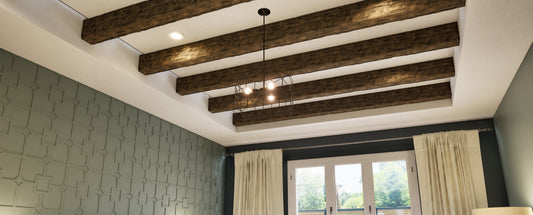
- Modern high-density polyurethane faux beams are virtually indistinguishable from real wood at ceiling height.
- Real wood remains the best choice for historic restorations and certain ultra-luxury applications where tactile authenticity matters at arm's reach.
If you're planning a beam ceiling project in the Sacramento or Bay Area region, you've probably landed on the same question every homeowner faces: real wood or faux? Ten years ago the answer depended on budget alone. Today, advances in polyurethane molding and hand-finishing techniques have made faux wood beams so realistic that most people can't tell the difference once they're mounted at ceiling height. For a deeper look at everything faux beams can do, see our Faux Wood Beams Ultimate Guide.
This article puts both materials under the same microscope — cost per linear foot, weight implications, installation logistics, maintenance schedules, and long-term durability — so you can make a confident decision for your home.
Cost Comparison: What You'll Actually Pay
Material cost is usually the first filter, and the gap between faux and real wood is substantial. High-density polyurethane faux beams typically run $8–25 per linear foot for the beam itself, depending on profile size and finish detail. Installed — including blocking, adhesive, and trim screws — expect $15–45 per linear foot in the Sacramento market.
Solid hardwood beams (oak, Douglas fir, cedar) start at roughly $30–60 per linear foot for the raw timber, but that's before milling, kiln-drying, and finishing. Once you factor in structural engineering review, potential header reinforcement, crane or lift rental for heavy timbers, and two-to-three-day labor, installed costs climb to $50–150+ per linear foot. Reclaimed barn beams — popular in wine-country builds around Napa and Sonoma — can push even higher, often $80–200 per foot once sourced, cleaned, and treated for indoor use.
For a typical Sacramento living room with four 12-foot beams (48 linear feet total), here's the math:
Cost at a Glance
|
Category |
Faux Wood Beams |
Real Wood Beams |
|
Material cost per LF |
$8–25 |
$30–60+ |
|
Installed cost per LF |
$15–45 |
$50–150+ |
|
48 LF project total |
$720–2,160 |
$2,400–7,200+ |
|
Structural work needed? |
Rarely |
Often ($500–2,000+) |
That 48-foot project could cost $720–2,160 in faux beams versus $2,400–7,200+ in real timber — before any structural modifications. If your ceiling joists aren't rated for the added load (common in California tract homes built before 2000), engineering and reinforcement alone can add $500–2,000.
Weight Differences: Why It Matters More Than You Think
Weight is the single most underestimated factor in beam ceiling projects. A standard 6×8-inch faux wood beam weighs roughly 1–2 pounds per linear foot. A solid Douglas fir beam of the same dimensions? About 12–18 pounds per foot. An oak beam of that profile pushes 18–24 pounds per foot.
That means a single 14-foot solid oak beam could weigh 250–340 pounds. Mounting that to a ceiling requires lag bolts into structural framing, possibly sister joists or a steel plate, and almost certainly a crew of three or four with scaffolding. A faux beam of the same length weighs 14–28 pounds — light enough for two people on ladders to position and secure with construction adhesive and trim screws into simple 2×4 blocking.
In earthquake-prone Northern California, ceiling weight carries additional implications. Lighter ceiling elements reduce seismic risk and keep your home's overall dead load well within code margins. This is particularly relevant for homes in Sacramento's Pocket-Greenhaven and Land Park neighborhoods, where many structures date to the 1950s–1970s an d weren't engineered for heavy decorative elements overhead.
Installation: DIY-Friendly vs. Professional-Only
Faux beam installation is one of the most approachable ceiling upgrades a homeowner can tackle. The process follows a straightforward sequence: mount 2×4 nailer blocks to the ceiling at 3–4 foot intervals, dry-fit the beam to check alignment, apply polyurethane adhesive to the inner channel, lift the beam over the blocks, and drive finish screws through the beam flanges into the blocking. Most rooms take a single afternoon.
Real wood beam installation is a different category of work. Heavy timbers need lag screws or through-bolts into structural members — not just drywall or ceiling joists. You'll likely need a structural engineer to confirm load paths, a building permit in most Sacramento County jurisdictions, and specialized lifting equipment. Lead time is also longer: solid beams need to be kiln-dried (or at least acclimated on-site for 1–2 weeks) to prevent checking, twisting, and gap formation after installation.
For homeowners considering the professional route for either option, our architectural design services team handles everything from beam layout to final install.
Maintenance: Decades of Easy Care vs. Annual Upkeep
Once faux beams are installed, maintenance is essentially zero. Dust them with a microfiber cloth or blow them off with a can of compressed air once or twice a year. The factory-applied finish won't fade, peel, or yellow under normal indoor conditions. Polyurethane is impervious to moisture, so you can run faux beams through kitchens, bathrooms, and even covered outdoor patios without worrying about swelling or rot.
Real wood demands more attention. Interior beams should be re-sealed or re-oiled every 2–3 years to maintain their finish and prevent drying cracks. In homes without consistent climate control — think vacation cabins in the Sierra foothills or seasonally occupied Bay Area second homes — wood expands and contracts with humidity swings, leading to visible checks (splits along the grain) within the first few years. Pest vulnerability is another consideration: untreated or poorly treated wood beams can attract powder post beetles and carpenter ants, both active in the Sacramento Valley.
Moisture Resistance, Pest Immunity & Fire Rating
High-density polyurethane beams are closed-cell — they don't absorb water, period. This makes them ideal for humid environments like pool houses, spa rooms, and covered outdoor kitchens where real wood would warp and decay within a few seasons. They're also completely immune to termites, carpenter ants, and wood-boring beetles.
On fire performance, faux beams made from Class A rated polyurethane meet or exceed building code requirements for interior decorative elements. They won't sustain a flame and produce minimal smoke. Real wood, while it can be treated with fire retardant, is inherently combustible and doesn't achieve the same rating without chemical treatment — which can alter the wood's color and finish.
Customization and Realism: Closing the Gap
The most common objection to faux beams — "they look fake" — hasn't been valid for years. Today's manufacturing uses molds cast from actual reclaimed timbers, capturing every saw mark, knot cluster, grain line, and weathering pattern from the original wood. Multiple layers of hand-applied stain and glaze create depth and color variation that reads as authentic even up close.
Our color matching and custom stain services take this further — we match faux beams to your existing flooring, cabinetry, or furniture so the beams look like they've always been part of the house. Browse completed projects in our project gallery to see how these finishes translate in real Sacramento and Bay Area homes.
Faux beams also offer flexibility real wood can't match. Need an L-shaped beam that wraps from ceiling to wall? A curved beam that follows an arched doorway? A hollow beam channel to conceal electrical conduit, speaker wire, or plumbing? All straightforward with faux. Achieving any of those in solid timber means expensive custom millwork and weeks of lead time.
Environmental Considerations
Sustainability-minded homeowners sometimes assume real wood is the greener choice. The reality is more nuanced. Solid timber beams — especially large-profile beams — require old-growth or large-diameter trees that take 50–100+ years to reach harvestable size. Reclaimed beams are more sustainable in principle, but sourcing, transporting, and processing them generates significant diesel miles and waste (damaged sections that can't be used).
Polyurethane faux beams are petroleum-derived, which isn't carbon-neutral. However, their light weight means dramatically lower shipping emissions per unit. A single pallet of faux beams covers the same linear footage as a flatbed truck of solid timber. And because faux beams last indefinitely without replacement, their lifetime environmental footprint compares favorably to real wood that may need replacement after 20–30 years in suboptimal conditions.
When Real Wood Is the Better Choice
Honesty matters, so here's when we'd actually recommend real wood over faux. If you're restoring a historic Craftsman bungalow in Midtown Sacramento or a Victorian in San Francisco's Pacific Heights, authentic materials may be required by local historic preservation standards — and they should be, because those homes deserve period-accurate details.
Ultra-luxury new construction where beams will be at eye level or within arm's reach — a great room with a 20-foot ceiling and a loft railing that puts you next to the beam surface — may also warrant real timber. At touching distance, the weight and thermal feel of actual wood is different, and discerning clients notice.
Structural applications where the beam must carry load (not just decorative) obviously require real engineered or solid timber. Faux beams are decorative by definition. However, for the vast majority of ceiling beam projects — estimated at 85–90% of what we see in the Sacramento and Bay Area market — faux beams deliver the same visual impact at a fraction of the cost, weight, and hassle.
From a strict ROI perspective, faux beams deliver more value per dollar invested. A $1,500–2,500 faux beam installation in a Sacramento-area home adds an estimated $3,000–6,000 in perceived value at resale. The same look in real timber, at $4,000–10,000+, offers the same perceived uplift — the math favors faux by a wide margin.
The key insight: buyers respond to the visual effect, not the material. A beautifully installed set of faux beams reads identically to real timber in listing photos and during showings. At ceiling height, even experienced contractors often cannot tell the difference without touching the surface — and nobody touches a 10-foot ceiling during an open house.
Sacramento realtors consistently report that ceiling beams — real or faux — boost perceived home value, particularly in open-concept living areas. A 2024 survey of Northern California staging professionals found that homes with beam ceilings photographed better, received more online listing engagement, and spent an average of 8 fewer days on market compared to comparable homes without architectural ceiling detail.
Resale Value and Buyer Perception
Complete Side-by-Side Comparison
|
Feature |
Faux Wood Beams |
Real Wood Beams |
|
Cost (installed/LF) |
$15–45 |
$50–150+ |
|
Weight per LF |
1–2 lbs |
10–24 lbs |
|
Installation time (4-beam room) |
3–6 hours |
1–3 days |
|
DIY feasible? |
Yes |
Rarely |
|
Structural engineering needed? |
No |
Usually |
|
Maintenance |
Dust annually |
Re-seal every 2–3 years |
|
Moisture resistant? |
100% |
Requires treatment |
|
Pest resistant? |
Immune |
Vulnerable without treatment |
|
Fire rating |
Class A available |
Combustible (treatable) |
|
Customization flexibility |
High (curves, channels, L-shapes) |
Limited without custom millwork |
|
Realism at ceiling height |
Virtually indistinguishable |
Authentic |
|
Lifespan |
Indefinite indoors |
20–50+ years with maintenance |
Making Your Decision
Start with three questions: What's your budget? Will the beams be within arm's reach? Does your project have historic preservation requirements? If the budget matters (it almost always does), beams are above head height (they almost always are), and you're not bound by historic guidelines, faux wood beams are the clear winner.
Still unsure? We're happy to bring samples of both faux and stained-finish options to your home so you can see and feel the difference in your own space. Contact us for an in-home consultation and estimate — we serve Sacramento, the Bay Area, and all of Northern California.