Modern Ceiling Design Ideas for Open-Concept Homes

Key Takeaways
- Ceiling treatments are the most effective way to define functional zones in open-concept homes without adding walls or bulky dividers.
- Height variations — tray ceilings, dropped soffits, and raised panels — create visual boundaries between kitchen, dining, and living areas.
- Material transitions (stretch ceilings paired with faux wood beams) anchor different zones while maintaining design cohesion.
- Layered, zone-specific lighting integrated into ceiling design eliminates the "one big room" problem.
- Restraint matters: stick to two or three complementary ceiling treatments per open floor plan to avoid visual chaos.
Open-concept floor plans dominate new construction across the Sacramento region — from the master-planned communities in Natomas and Elk Grove to custom builds in Roseville and Folsom. The appeal is obvious: natural light flows freely, families stay connected, and the square footage feels generous. But open floor plans come with a design challenge that most homeowners discover only after move-in: without walls, every zone bleeds into the next. The kitchen island drifts into the living room. The dining area feels like an afterthought. The entire main floor reads as one undifferentiated rectangle.
The ceiling is the solution most people overlook. While interior designers have long used rugs, furniture arrangement, and paint colors to suggest zones, ceiling design does the heavy architectural lifting. A well-planned ceiling creates unmistakable boundaries — you feel the transition from kitchen to living room — without closing off the space. For a comprehensive overview of ceiling design approaches for every room, see our full guide on ceiling design ideas for every room.
Below, we break down six proven strategies for using ceiling design to transform open-concept spaces — from height changes and material transitions to lighting plans and color strategies. Each approach works independently, but the strongest open-concept ceilings combine two or three of these techniques.
Defining Zones With Ceiling Height Variation
The fastest way to signal "you've entered a different space" is to change the ceiling height. In an open floor plan with standard 9-foot ceilings, even a 6-inch drop or raise creates a perceptible shift. The human brain registers that change subconsciously — it reads a lower ceiling as intimate and a higher ceiling as expansive.
Tray Ceilings to Mark Living Areas
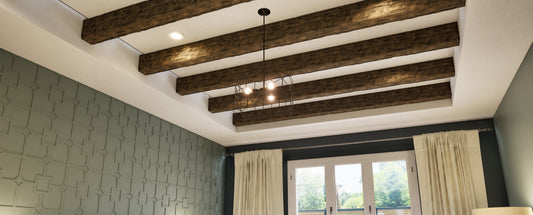
A tray ceiling (also called a recessed or inverted ceiling) raises the center portion of the ceiling by 6 to 12 inches, creating a framed, elevated panel. In an open-concept home, installing a tray ceiling above the living room seating area instantly marks that zone as the primary gathering space. The raised section draws the eye upward, making the living area feel taller and more formal than the surrounding zones. Standard tray construction starts at 9-foot ceiling height — anything lower risks feeling cramped in the perimeter area.
Dropped Soffits Over Kitchen Zones
On the opposite end, dropping the ceiling 8 to 14 inches over a kitchen island or the cooking zone creates a canopy effect. This lower ceiling makes the kitchen feel contained and task-oriented — even as it remains visually open to the living and dining areas. A dropped soffit also provides a natural housing for recessed downlights or pendant fixtures positioned directly over work surfaces. In kitchen ceiling installations, we frequently combine a soffit with integrated LED strips along the perimeter to create a clean, modern look that separates the cooking zone from the rest of the floor plan.
Stepped Transitions
Rather than an abrupt change, a stepped or layered ceiling transitions between zones using two or three incremental height shifts — say, 9 feet over the kitchen, 9.5 feet in the transition zone, and 10 feet in the living room. This creates a gradual visual flow that feels organic rather than jarring. Stepped designs work especially well in long, rectangular floor plans common in Northern California tract homes, where a single abrupt line would feel arbitrary.
Material Transitions: Mixing Ceiling Treatments Across Zones
Changing the ceiling material from one zone to the next is a powerful design move. The contrast between textures — smooth versus rough, reflective versus matte — tells your eye that the space has shifted. The trick is choosing materials that complement each other so the overall floor plan still reads as unified.
Stretch Ceilings in the Living Area, Beams Over the Kitchen
One of the most effective combinations we install in open-concept Sacramento homes pairs a clean, seamless stretch ceiling in the living room with exposed faux wood beams spanning the kitchen and dining area. The stretch ceiling gives the living zone a sleek, contemporary finish — no seams, no texture, just a flawless plane. The beams introduce warmth, rhythm, and a sense of structure over the kitchen island and dining table. This pairing works because the two materials occupy different visual registers: the stretch ceiling recedes, letting furniture and decor take center stage, while the beams draw attention upward in the functional zones where architectural interest matters.
Glossy and Matte Zones
For a more subtle material transition, consider using different finishes of the same stretch ceiling membrane. A lacquer (glossy) stretch ceiling over the dining area reflects chandelier light and creates drama, while a matte finish over the adjacent living room keeps the mood relaxed. Because both surfaces are stretch membrane, the transition is seamless — literally. A single aluminum profile can divide the two finishes in a perfectly straight line, creating a clean boundary visible from every angle.
Lighting Design: Making Open Spaces Feel Intentional
Lighting might be the single most important factor in making an open-concept ceiling design work. Without zone-specific lighting, even the most beautiful ceiling treatments blur together after dark. The goal is layered lighting — ambient, task, and accent — controlled independently by zone.
Cove Lighting for Zone Boundaries
LED cove lighting installed along the perimeter of a tray ceiling or soffit creates a soft glow that outlines the zone. Warm white (2700K–3000K) LEDs along a living room tray ceiling produce a relaxed, ambient feel. Cooler white (3500K–4000K) strips in a kitchen soffit deliver better task lighting over countertops. This temperature difference — imperceptible in a hardware store but unmistakable when installed overhead — reinforces the zone boundary. Backlit ceiling panels take this concept further by turning an entire ceiling section into a uniform light source, mimicking natural daylight in interior zones that lack windows.
Layered Fixture Selection
Each zone should have its own primary fixture type. A flush-mounted LED panel or recessed downlights work cleanly in the kitchen. A statement chandelier or sculptural pendant anchors the dining area. Recessed adjustable spots or indirect cove lighting handles the living room. When each zone has a distinct fixture language, the ceiling design becomes readable even in a completely open floor plan. Plan for independent dimmer circuits per zone — this is non-negotiable if you want the flexibility to set different moods in connected spaces.
Color Strategies for Open-Concept Ceilings
Ceiling color is an underused tool. Most open-concept homes default to flat white across the entire ceiling plane, which does nothing to differentiate zones. Intentional color choices add depth and definition without any structural changes.
Monochrome for Flow
If your priority is making the space feel as large and connected as possible, use a single color across the entire ceiling but vary the sheen. A matte white in the hallway, eggshell in the living room, and semi-gloss in the kitchen creates tonal shifts that register subconsciously. The space flows, but each zone has a slightly different character. This approach is ideal for smaller open-concept layouts (under 600 square feet of combined floor area) where strong contrasts could feel choppy.
Contrast for Definition
In larger open floor plans — the 800- to 1,200-square-foot great rooms typical of newer Sacramento homes — a bolder approach works. Paint the tray ceiling above the living room a deep charcoal or navy. Leave the kitchen ceiling bright white. Use a warm greige over the dining area. These deliberate color blocks, viewed from any vantage point in the room, read as three distinct zones sharing one space. The color contrast is especially effective when paired with height changes: a recessed tray ceiling in a dark hue reads as dramatically taller because the dark color visually recedes.
Common Mistakes to Avoid in Open-Concept Ceiling Design
We've seen enough open-concept projects in the Sacramento and Bay Area markets to know where homeowners (and some contractors) go wrong. These are the mistakes that turn an ambitious ceiling plan into a visual headache.
Too Many Competing Treatments
The most common error: using a different ceiling treatment in every zone. Beams over the kitchen, a tray in the living room, a coffered grid in the dining area, and a skylight in the hallway — all in one open floor plan. Each treatment might look beautiful in isolation, but together they create visual noise. The ceiling fights for attention instead of supporting the room. Rule of thumb: choose a maximum of two ceiling treatments for any single open-concept space. Let one dominate (covering 60–70% of the area) and use the second as an accent over a specific zone.
Ignoring Sightlines
Open-concept means every ceiling treatment is visible from multiple angles — including the transition points. A beautiful tray ceiling that ends with an ugly drywall bulkhead visible from the kitchen ruins the effect. Before committing to a ceiling plan, stand in every corner of the open space and look up. The transitions between zones need to look clean and intentional from every vantage point. This is where stretch ceilings excel: the aluminum track profiles create razor-straight transition lines that look finished from every angle, unlike traditional drywall transitions that require extensive taping, mudding, and sanding.
Forgetting About Scale
A 4-inch-deep tray ceiling that looks elegant in a standard 12×14 bedroom disappears in a 25×30 great room. Open-concept spaces demand proportional scale. Ceiling features need to be bolder — deeper trays (10–12 inches), wider beams (6–8 inches), larger coffers. Subtle details get lost in big rooms. Conversely, if your open floor plan is on the smaller side (common in Bay Area condos and remodels), oversized ceiling features will feel oppressive. Match the ceiling feature's scale to the room's square footage and ceiling height.
Putting It All Together: A Room-by-Room Ceiling Plan
The strongest open-concept ceilings aren't designed zone by zone — they're planned as a unified system. Here's a framework we use with clients at Elite Ceiling Designs:
- Start with the primary zone. Identify the most important area in your open floor plan (usually the living room) and choose the hero ceiling treatment — a tray ceiling, a stretch ceiling panel, or a dramatic backlit feature.
- Select a secondary treatment. Pick one complementary material or technique for the adjacent zone. If the living room has a smooth stretch ceiling, consider faux wood beams over the kitchen island. If the living room has a tray, use a flat ceiling with cove lighting in the kitchen.
- Use lighting to reinforce the boundaries. Install zone-specific lighting on separate dimmers. Warm cove lighting in the living area, task-focused recessed fixtures in the kitchen, a statement pendant over the dining table.
- Test from every angle. Walk the full floor plan and assess each transition. Are the boundaries clear? Do the treatments complement each other? Is there a cohesive color and material palette tying everything together?
To see completed open-concept ceiling projects from Sacramento and Bay Area homes, browse our project gallery. For room-specific inspiration, explore our living room ceiling designs and kitchen ceiling installations.
Open-concept ceiling design is equal parts architecture and strategy. The right combination of height variation, material contrast, lighting, and color transforms a featureless rectangle into a home that feels both open and intentionally organized. Whether you're building new in Roseville, remodeling a ranch home in Elk Grove, or updating a Bay Area condo, the ceiling is your most powerful — and most overlooked — design tool.
Ready to plan your open-concept ceiling? Contact Elite Ceiling Designs for an in-home consultation. We serve Sacramento, the Bay Area, and all of Northern California.