Small Room Ceiling Tricks: How to Make Low Ceilings Look Higher
KEY TAKEAWAYS
- Glossy lacquer stretch ceilings reflect the room below, creating the illusion of double the ceiling height — the single most effective trick available.
- Stretch ceilings steal only 1 inch of headroom compared to 4–6 inches lost with traditional drop ceilings.
- Light-colored ceilings (white, pale gray, soft blue) visually recede, making them appear farther away.
- Recessed lighting and backlit panels eliminate hanging fixtures that crowd low ceilings.
- Painting walls and ceiling the same color erases the visual boundary, making the room feel open and continuous.
- Removing or minimizing crown molding can reclaim 3–5 inches of perceived height in rooms with 8-foot ceilings.
Standard 8-foot ceilings are one of the most common frustrations Sacramento homeowners mention during consultations. Thousands of homes built across the Sacramento Valley and Bay Area between the 1960s and 1980s share this same characteristic: functional ceiling heights that feel cramped the moment you add furniture, shelving, or a ceiling fan. The good news? You do not need a costly structural renovation to fix the problem. A combination of optical illusions, smart material choices, and strategic lighting can make your existing ceiling feel dramatically taller — often for a fraction of the cost of raising the actual structure. For a full exploration of ceiling design approaches for every room, see our complete guide to ceiling design ideas for every room.
This guide covers the most effective techniques we use and recommend at Elite Ceiling Designs, ranked roughly by impact. Some are weekend DIY projects; others require professional installation. All of them work.
Glossy Lacquer Stretch Ceilings: The Single Best Trick for Low Rooms
If you take away one idea from this article, let it be this: a high-gloss lacquer stretch ceiling transforms a cramped room faster and more dramatically than any other single change. The surface acts like a mirror mounted overhead, reflecting the floor, furniture, and ambient light back into the space. The result is a perceived ceiling height that can feel nearly double the actual measurement.
In an 8-foot room, a glossy white or light gray lacquer membrane creates an uninterrupted reflection that tricks the eye into reading the space as 14 to 16 feet. The effect is strongest in rooms with lighter flooring — hardwood, light tile, or pale carpet — because there is more reflected light bouncing upward.
Critically, a stretch ceiling installation sacrifices only about 1 inch of actual headroom. The membrane fastens to a perimeter track mounted along the wall, and the material spans the gap without a bulky grid or support structure. Compare that to a conventional drop ceiling (also called a suspended ceiling), which typically eats 4 to 6 inches of clearance — sometimes more when accommodating recessed lighting cans. For a room that already feels tight at 96 inches, losing half a foot to a drop grid is the last thing you want.
Before-and-After: Sacramento Ranch Home
One of our recent projects involved a 1972 ranch-style home in the Arden-Arcade neighborhood with original popcorn ceilings at 8 feet. The homeowner wanted to modernize the living room without tearing out the popcorn texture — a messy, dust-heavy process that can also involve asbestos testing. We installed a glossy white lacquer stretch membrane directly below the existing popcorn, dropping the measured ceiling to 7 feet 11 inches. Despite technically losing an inch of height, the homeowner reported the room felt twice as open. Guests consistently describe it as having vaulted ceilings — until they're told otherwise.
Choose Light, Cool Colors for the Ceiling Surface
Color psychology and basic optics work together here. Light colors reflect more ambient light and appear to recede from the viewer, while dark tones absorb light and seem closer. For low ceilings, the ideal palette includes pure white, off-white, very light gray (Benjamin Moore's Paper White or Sherwin-Williams Snowbound are popular picks), and pale blue. Pale blue is especially effective because our brains associate it with open sky — an automatic cue for height and expansiveness.
If you're installing a satin stretch ceiling, the semi-reflective sheen adds a subtle glow without the full mirror effect of lacquer. Satin finishes in white or ivory work well in bedrooms and hallways where a full gloss surface might feel too intense. The gentle light diffusion still pushes the ceiling visually upward, typically adding a perceived 6 to 12 inches beyond the actual measurement.
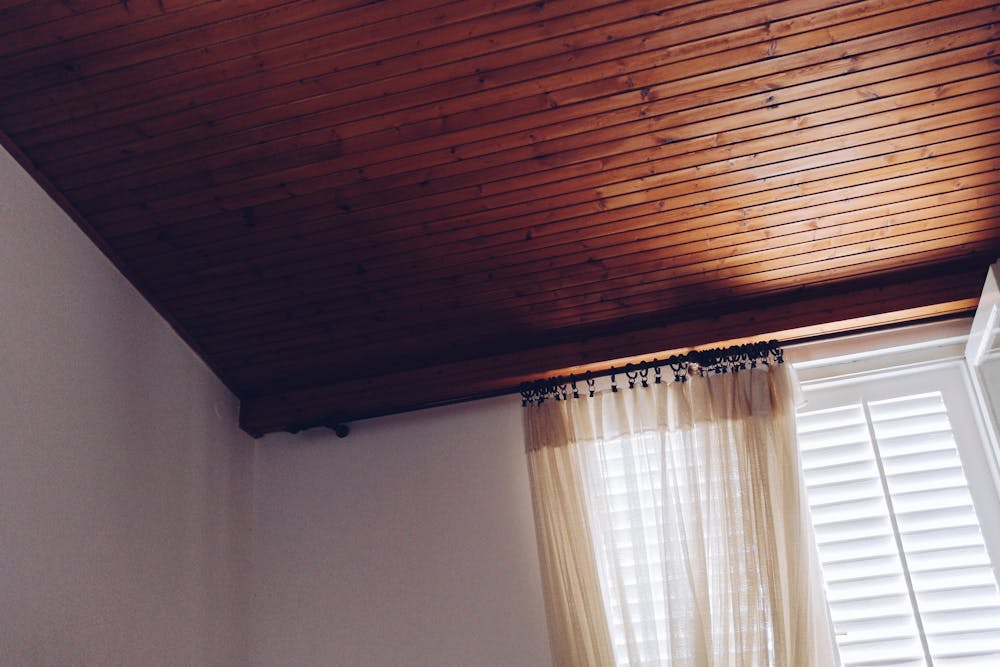
Avoid warm, saturated tones on low ceilings. Terra cotta, deep gold, or dark brown ceilings — trends from the early 2000s — pull the surface toward the viewer and make a room feel cave-like. Reserve those colors for accent walls or rooms with at least 9.5-foot ceilings where there is headroom to spare.
Swap Hanging Fixtures for Recessed or Backlit Lighting
A standard pendant light or chandelier hangs 12 to 18 inches below the ceiling plane. In a room with 8-foot ceilings, that puts the fixture at roughly eye level for anyone taller than 5'10" — and it creates a visual obstacle that makes the ceiling feel even lower. The fix is straightforward: replace hanging fixtures with recessed cans, ultra-slim LED panels, or a full backlit stretch ceiling.
Recessed downlights sit flush with (or slightly above) the ceiling surface, removing any visual obstruction. Modern LED recessed lights are only 0.5 to 1 inch deep, making them compatible with stretch ceiling installations where space above the membrane is limited. They provide clean, even illumination without drawing attention to the ceiling plane itself.
Backlit stretch ceilings take this a step further. An LED light panel is installed above a translucent stretch membrane, turning the entire ceiling into a uniform light source. The effect resembles a skylight that spans the whole room. Because the light appears to come from above and behind the surface, the brain reads the ceiling as farther away — similar to how a bright, overcast sky feels boundless even though clouds are only a few thousand feet up. Backlit installations are especially powerful in windowless rooms like interior bathrooms, basement spaces, and walk-in closets.
Paint Walls and Ceiling the Same Color
This is one of the simplest tricks in the book, and it costs nothing extra if you're already repainting. When the wall color and ceiling color match exactly, the hard line where wall meets ceiling disappears. Without that visual boundary, the eye travels upward without interruption, and the room reads as taller and more open.
White-on-white is the classic approach, but this technique works with any light neutral — soft gray, warm linen, barely-there blue. The key is using the exact same paint (same brand, same sheen) on both surfaces. Even a slight mismatch creates a visible line that defeats the purpose. If your walls are a matte finish, use matte on the ceiling too. A satin wall paired with a flat ceiling will still show a contrast at the junction.
For homeowners who want a more finished look, a stretch ceiling membrane can be color-matched to virtually any wall paint shade. We frequently match stretch ceiling membranes to Benjamin Moore or Sherwin-Williams colors by providing the RAL or Pantone equivalent to the manufacturer. The result is a seamless transition from wall to ceiling that looks intentional and architecturally cohesive.
Remove or Minimize Crown Molding
Crown molding was a staple of builder-grade homes throughout the 1980s and 1990s, and many Sacramento homeowners assume it adds value. In rooms with generous ceiling heights, it can. But on an 8-foot ceiling, a 4- to 5-inch crown molding profile visually lowers the ceiling line by exactly that amount. Your eye reads the bottom edge of the molding as the ceiling, not the actual plane above it.
Removing crown molding and filling the nail holes creates an immediate sense of added height. If you prefer some visual trim at the wall-ceiling junction, a slim 1-inch reveal or a simple L-channel (the type used to finish stretch ceiling perimeters) provides a clean, modern line without stealing headroom. This small change, combined with the wall-ceiling color match described above, can make a room feel 6 to 8 inches taller with no structural work at all.
Use Vertical Lines to Direct the Eye Upward
Vertical stripes on walls, tall narrow mirrors, floor-to-ceiling curtains, and vertically oriented wall paneling all create upward visual momentum. The principle is the same one that makes vertical stripes on clothing create a taller, slimmer silhouette. In a room with low ceilings, mount curtain rods as close to the ceiling line as possible — ideally touching it — and let curtains fall all the way to the floor. This unbroken vertical line from ceiling to floor extends the perceived wall height dramatically.
Tall, narrow bookcases and floor-to-ceiling shelving units achieve a similar effect. Avoid short, wide furniture groupings that emphasize the horizontal plane. When selecting wall art, choose portrait-oriented pieces over landscape-oriented ones and hang them slightly higher than you normally would — the top of the frame should sit about 8 to 10 inches below the ceiling, drawing the gaze upward.
Incorporate Mirror and Metallic Accents
Mirrors placed on walls opposite windows bounce natural light onto the ceiling, brightening it and making it recede. A single large mirror — 36 by 48 inches or bigger — leaned against a wall or mounted vertically can transform the light dynamics of an entire room. Metallic picture frames, polished brass sconces, and chrome hardware serve a similar function on a smaller scale, scattering light across the ceiling surface.
This effect compounds when paired with a glossy or satin stretch ceiling. The ceiling reflects the light from the mirror, the mirror reflects light from the ceiling, and the room fills with a soft ambient glow that erases hard boundaries. In Bay Area condos with compact footprints and standard 8-foot ceilings, this combination is one of the most reliable ways to make 600 square feet feel like 900.
What to Avoid: Heavy Beams and Dark Overhead Elements
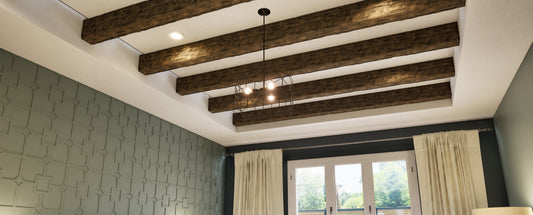
Exposed beams are gorgeous in rooms with 10-foot or higher ceilings, where they add architectural character without crowding the space. On an 8-foot ceiling, however, even a modest 6-inch faux beam drops the visual ceiling line to 7'6" and creates a heavy, oppressive feeling. Dark-stained beams are especially problematic because the contrast between a dark beam and a light ceiling draws the eye directly to the lowest point in the room.
If you love the beam aesthetic but have low ceilings, consider a compromise: thin, shallow decorative planks in a light whitewash or natural blonde finish. At 2 to 3 inches deep, they add texture without significant height loss. Or skip overhead beams entirely and use a faux beam mantel over the fireplace instead, where the beam serves as a focal point without compressing the room's vertical space.
Putting It All Together: A Practical Room Makeover
Here is what a comprehensive low-ceiling makeover looks like for a typical 12-by-14-foot Sacramento living room with 8-foot ceilings, popcorn texture, and a dated ceiling fan:
Step 1: Remove the ceiling fan and any crown molding. Patch and sand the wall-ceiling junction. Cost: $150–$300 if hiring a handyperson.
Step 2: Install a glossy white lacquer stretch ceiling membrane over the existing popcorn. The track system mounts at 1 inch below the original ceiling. Total installed cost for this room size: approximately $1,800–$2,600 depending on lighting integration.
Step 3: Integrate 4 to 6 ultra-slim recessed LED downlights into the stretch membrane. These provide even, shadowless light without any fixtures hanging below the ceiling plane.
Step 4: Paint all four walls the same white as the ceiling (or the closest match). One coat of primer plus two coats of finish paint: roughly $200–$350 in materials for a DIY job.
Step 5: Hang curtain rods at ceiling height with floor-length curtains in a light neutral fabric. Budget: $150–$400 depending on fabric quality.
Step 6: Place a large mirror on the wall opposite the main window.
Total project cost: roughly $2,500 to $3,800. Total actual height lost: 1 inch. Perceived height gained: 4 to 8 inches or more, depending on furnishings and natural light. The difference is transformative — and every element is reversible if you ever want to change direction.
Ready to see what these techniques can do for your home? Our team at Elite Ceiling Designs serves Sacramento, the Bay Area, and surrounding communities throughout Northern California.