The Ultimate Guide to Spanish Colonial & Mission Revival Details

Southern California has a distinct architectural language. It’s written in white stucco, red clay tiles, and the deep shadows cast by heavy timber beams. While modern farmhouse and contemporary styles have their place, nothing defines the landscape of San Diego, Santa Barbara, and Los Angeles quite like Spanish Colonial and Mission Revival architecture. These styles aren't just historic footnotes; they are the enduring identity of the region.
For homeowners and builders in SoCal, getting Spanish Colonial architectural details right is the difference between a home that feels authentic and timeless, and one that feels like a cheap theme park imitation. It’s about more than just slapping some arches on a facade. It requires a deep understanding of proportion, material, and history. Whether you are restoring a 1920s original or building a new custom home in a historic style, the details matter. This guide explores the essential elements that define this aesthetic and how modern materials can help you achieve the look with greater durability and ease.
The Roots of Spanish Colonial Architecture in Southern California
To understand why Southern California Spanish style homes look the way they do, you have to look at the history and the climate. The Panama-California Exposition in San Diego in 1915 is often cited as the catalyst that popularized the Spanish Colonial Revival style. Architects like Bertram Goodhue looked to Spain and Mexico for inspiration, creating a romanticized version of the colonial past that fit perfectly with California’s Mediterranean climate.
The history of Spanish Colonial architecture California embraced wasn't just about aesthetics; it was practical. Thick stucco walls provided thermal mass to keep interiors cool during hot days. Small windows minimized heat gain. Courtyards created protected outdoor living spaces shielded from the wind. Mission Revival architecture California developed alongside it, drawing specifically from the California missions with their distinctive parapets and bell towers.
Today, these styles remain dominant because they work. They blur the lines between indoor and outdoor living—a hallmark of the California lifestyle. California Mediterranean home styles have evolved, but the core DNA remains the same: a connection to the earth, a respect for the sun, and a reliance on simple, honest materials.
Defining Spanish Colonial Architectural Details
You know a Spanish style home when you see it, but breaking down exactly why it works helps in designing or remodeling one. The magic lies in the interplay of a few key Spanish Colonial architectural details. It is a style of contrasts: smooth walls against rough wood, bright light against dark shadows.
Stucco Walls and Clay Tile Rooflines
The canvas for any Spanish style home exterior features is the wall itself. Authentic Spanish homes use hand-troweled stucco. It’s not the flat, machine-sprayed texture of a tract home; it has undulation and life. The white or creamy beige color reflects the sun, keeping the home cool.
Capping these walls are the low-pitched roofs covered in red clay tiles (tejas). These stucco walls red tile roof combinations are iconic. The heavy tiles provide insulation and durability, shedding water easily during winter rains while withstanding the relentless summer sun. The rooflines are often complex, with multiple levels and sheds that break up the mass of the building, creating a picturesque silhouette against the sky.
Arched Openings and Iron Accents
Curves are essential to softening the mass of a Spanish home. Arched windows California homes feature are often deeply recessed. This depth is critical—it implies that the walls are thick masonry, even if they are modern wood framing. You’ll see arches in entryways, breezeways, and interior transitions.
To balance the softness of the arches and stucco, wrought iron is used for contrast. Black iron grilles over windows, ornate iron railings on balconies, and heavy iron hardware on doors provide a masculine, grounding element. The ironwork is often intricate, adding a layer of fine detail to the otherwise simple forms of the building.
Courtyards and Indoor-Outdoor Flow
Perhaps the most defining feature is the courtyard. In traditional Spanish architecture, the home focuses inward. The courtyard is an outdoor room, often centered around a fountain or a fireplace. It offers privacy and protection.
This design philosophy drives the indoor-outdoor flow that Southern California is famous for. French doors open from the living room and bedrooms directly onto the courtyard or loggia. The flooring often continues from inside to outside, using terracotta pavers or stone to dissolve the boundary between the interior and the garden.
Mission Revival Beams: A Signature Structural Aesthetic
If stucco and tile are the skin of the home, beams are the bones. Mission Revival beams provide the visual weight that anchors the airy, high-ceilinged spaces. In historic adobe structures, these beams (vigas) were actual structural logs supporting the heavy mud roof. Today, they are primarily aesthetic, but they must look structural to feel right.
Exposed Wood Beams in Vaulted Ceilings
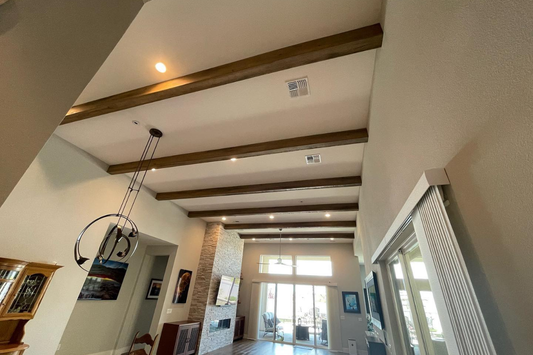
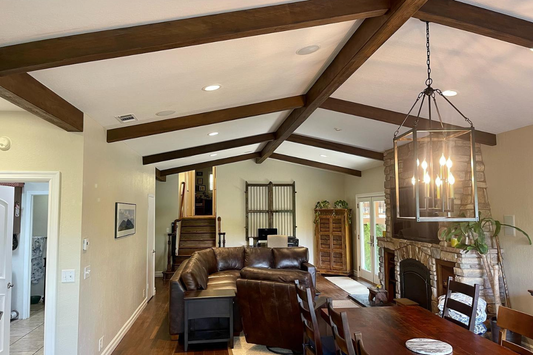
Walk into a grand living room in Santa Barbara or Pasadena, and look up. The exposed wood beams Spanish homes feature are almost mandatory in main living areas. Dark, heavy timbers spanning a white plaster vaulted ceiling create a rhythm and scale that defines the room.
These decorative ceiling beams Spanish style homes use often feature a "corbel" or support block where the beam meets the wall, further emphasizing the idea that these timbers are holding up the roof. The wood is usually stained in dark espresso or walnut tones to contrast sharply with the white ceiling, drawing the eye upward and emphasizing the volume of the space.
Beam Tails and Corbels on Exterior Facades
The beam aesthetic doesn't stop at the front door. Rustic wood beams California architecture utilizes often extend through the walls to the exterior. "Beam tails" or "rafter tails" sticking out under the roof eaves are a classic detail.
These projecting beam ends add texture to the roofline. They cast repeating shadows that change throughout the day, adding visual interest to the plain stucco walls. Often, these tails are shaped or scrolled, adding a decorative flourish to a functional element.
Heavy Timber Look with Modern Applications
The challenge with traditional heavy timber is weight and maintenance. Solid wood beams of this scale are incredibly heavy, requiring expensive structural engineering to support. They are also prone to twisting, cracking, and rot, especially on the exterior.
This is where modern solutions like high-density polyurethane beams shine. They offer the exact look of hand-hewn, distressed timber—complete with grain texture, checks, and knot holes—but weigh a fraction of real wood. This allows designers to add Mission Revival beams to existing ceilings without reinforcing the roof structure, making them an ideal solution for remodels.
Interior Architectural Elements That Define the Style
The interior of a Spanish Revival home should feel cool, calm, and solid. The clutter of Victorian design is stripped away in favor of bold forms and honest materials. Spanish style interior design California embraces is about "warm minimalism."
Hand-Troweled Plaster and Textured Finishes
Drywall with a standard orange-peel texture looks out of place in a Spanish home. The walls should look like plaster. Smooth-trowel or "Santa Barbara" finishes provide a subtle, organic texture that catches the light beautifully.
The corners are often "bullnosed" or rounded, rather than sharp 90-degree angles. This softness mimics the look of adobe construction and contributes to the relaxed, inviting atmosphere. Niches (nichos) carved into the walls provide spots for art or candles, further emphasizing the thickness of the walls.
Decorative Ceiling Treatments
While the exposed wood beams Spanish homes are famous for are the most common treatment, Spanish Colonial ceiling design can get quite elaborate. In dining rooms or libraries, you might see coffered ceilings with decorative painting between the beams.
Another classic look is the use of wood planking (tongue and groove) between the beams. This adds warmth and acoustic dampening. In hallways or smaller rooms, a "barrel vault" ceiling—a continuous arch—creates a dramatic tunnel effect, often highlighted with strategic lighting.
Warm Wood Tones Against Light Walls
The color palette is simple: creamy white walls and warm wood. The wood appears in the beams, the doors, the floors, and the cabinetry. Mediterranean interior details rely on this contrast.
The wood should look aged and substantial. Rustic walnut, distressed oak, or dark-stained pine are common choices. The goal is to make the woodwork look like it has been there for a century. This warmth prevents the white walls from feeling clinical or cold.
Exterior Beam Applications in Southern California Spanish Style Homes
In Southern California, we live outside. The exterior architecture is just as important as the interior. Southern California Spanish style homes use beams to define these outdoor spaces and link them to the main structure.
Covered Loggias and Patios
The "loggia" is an open-sided gallery or arcade, usually facing the garden. It provides shade, which is essential in our climate. The roof of the loggia is typically supported by heavy beams resting on thick columns or arches.
Exterior beam accents Spanish homes use in these spaces create a ceiling for the outdoor room. Looking up from the patio furniture, you should see rich wood textures, not just plywood or stucco. This attention to detail makes the outdoor space feel finished and luxurious. Mission style patio beams often span large distances, requiring substantial depth to look proportional.
Entryway Beam Accents
The front entry is the prelude to the home. A timber trellis or pergola over the walkway is a common feature. It filters the sunlight and supports climbing bougainvillea or jasmine.
Over the front door itself, a heavy timber header or a set of decorative corbels adds gravity to the entrance. These decorative gable beams California homes feature frame the opening and signal that you are entering a solid, protected space.
Balancing Ornament with Simplicity
Spanish architecture can be ornate (think Churrigueresque style with intense carving) or simple (Mission style). For most residential homes, the balance leans toward simplicity.
The beams provide the ornament. A well-placed, beautifully textured beam tail is often decoration enough. Overloading the exterior with too much "gingerbread" kills the clean lines of the style. The beams should feel muscular and necessary, not tacked on.
Proportion, Scale, and Authenticity in Spanish Revival Design
The biggest mistake in modern Spanish builds is getting the scale wrong. Authentic Spanish Revival design is all about mass. Things need to look thick, heavy, and permanent.
Beam Sizing for Tall Ceilings
A 12-foot high vaulted ceiling cannot be anchored by a dinky 4x6 beam. It will look like a toothpick. It feels weak. Mediterranean architecture proportions require usually start at 6x8 and go up to 10x12 or even larger for main ridge beams.
Mediterranean architecture proportions dictate that the structural elements must look capable of doing the work. Even if the beams are decorative faux wood, they must be sized as if they were real load-bearing timbers. Elite Ceiling Designs’ ability to manufacture large-scale custom beams allows designers to get this proportion right without worrying about the immense weight of a solid 12x12 timber.
Avoiding Over-Scaled Decorative Elements
Conversely, you can go too big. A small powder room doesn't need a massive truss. Spanish Colonial remodel California projects sometimes suffer from "mansion-itis," where details from grand estates are shoehorned into modest bungalows.
Authenticity comes from appropriateness. The beams should fit the room. The corbels should fit the beam. A good design rule is to look at historic precedents. Visit the Adamson House in Malibu or the Casa del Herrero in Montecito. Observe how they handle scale. The details are always subservient to the whole composition.
Modern Materials That Support Spanish Colonial Architectural Details
We love the look of the 1920s, but we don't love the maintenance of the 1920s. Wood rots. It gets eaten by termites. It twists in the sun. Southern California architectural materials need to be tougher.
Achieving the Look of Solid Timber Without Structural Bulk
High-density polyurethane beams are a game-changer for this style. They are molded from actual timber, capturing every grain pattern, axe mark, and wire-brushed texture. Once installed and stained, they are indistinguishable from wood to the naked eye.
Lightweight decorative beams California builders use solve the engineering headaches. You can create complex truss systems, massive ridge beams, and intricate ceiling grids that would be structurally impossible or prohibitively expensive with solid wood. This opens up design possibilities for faux wood beams Spanish style applications that were previously out of reach for many budgets.
Durability in Sun-Exposed Climates
The Southern California sun destroys exterior wood. A real wood beam tail exposed to the south will peel and crack within a few years, leading to water intrusion and dry rot.
Low maintenance Spanish home materials like polyurethane are impervious to moisture and highly resistant to UV degradation. They don't rot. They don't attract termites. This makes them ideal for exterior applications like rafter tails, patio covers, and pergolas. You get the romantic look of old wood without the reality of constant sanding and staining.
Updating Spanish Colonial and Mission Revival Homes Today
How do you live modern in a historic style? Spanish Colonial remodel ideas often focus on opening up the floor plan while keeping the vibe intact.
Opening Floor Plans While Preserving Character
Historic Spanish homes often had small, separated kitchens. Modern life revolves around the great room. When walls come down, you lose definition.
Beams are the solution. By running modern Spanish style renovation California beams across the ceiling where walls used to be, you subtly define the "kitchen" zone and the "dining" zone without blocking the view. The ceiling topography replaces the walls as the organizing element. This creates a large, airy space that still feels cozy and structured.
Integrating Modern Lighting and Beam Layouts
Lighting is another challenge. You want recessed cans and pendants, but you don't want to riddle your beautiful plaster ceiling with holes.
Blending modern and Spanish architecture often involves integrating lighting into the beams themselves. Hollow faux beams can act as a chase for wiring. You can mount chandeliers directly to the beams or hide LED strip lighting on top of them to wash the vaulted ceiling in a soft glow. This highlights the architectural details while providing the functional light needed for Southern California home renovation trends.
Why Spanish Colonial Details Still Define Southern California
Trends come and go, but the Spanish style endures. It fits our landscape. The red tiles echo the dry hills; the white walls reflect the bright sun; the courtyards shelter us from the ocean breeze.
Spanish Colonial architectural details are not just decoration; they are a language of comfort and permanence. Whether it’s the rhythm of Mission Revival beams California residents love or the cool touch of a plaster wall, these elements make a house feel like a home.
For those building or remodeling in this style, the goal is authenticity. It’s about honoring the Southern California Spanish style homes of the past by using the best materials of the present. With solutions like Elite Ceiling Designs’ architectural beams, you can achieve the heavy, historic aesthetic that anchors the design, while enjoying the lightweight durability that modern construction demands. It is the perfect marriage of old-world charm and new-world practicality, ensuring that the legacy of Spanish architecture in California remains strong for generations to come.
If you're planning a remodel or new build, the details you choose will shape the entire space. Ceiling beams can either blend in or become a defining architectural feature depending on how they’re designed.
Browse our faux beam styles and finishes or reach out to our team to plan a design that fits your home and location.