Seismic Safety and Lightweight Architectural Materials

Living in California means living with the reality of earthquakes. For homeowners and builders in the Bay Area, seismic safety isn't just a box to check on a permit application; it’s a fundamental part of how we design, build, and renovate. When we talk about earthquake preparedness, the conversation usually starts with foundations, sheer walls, and bolting. These are critical, but they aren't the whole story.
There is a significant, often overlooked factor in seismic safety: weight. Specifically, the weight of the decorative and architectural elements we add to our homes. Heavy materials like solid timber beams, precast concrete, and natural stone add massive loads to a structure. In a seismic event, that added mass translates into added force.
At Elite Ceiling Designs, we believe you shouldn't have to choose between the architectural style you love and the safety of your home. By choosing lightweight architectural materials for seismic zones, you can achieve the look of heavy timber or stone without the dangerous structural penalty.
Why Weight Matters in Earthquakes: A Reality for Bay Area Homes
When the ground shakes, your house moves with it. The amount of force your home experiences during that movement is directly related to its mass. It’s simple physics: Force equals Mass times Acceleration ($F=ma$). The heavier the building, the more force the earthquake exerts on it.
For Bay Area homes, this is a critical consideration. Many of our local architectural styles—from Spanish Colonial Revivals in San Jose to Craftsman bungalows in Berkeley—were originally built with heavy materials. While these structures have charm, their weight can work against them during seismic activity.
Reducing the weight of your home, even in non-structural areas, reduces the seismic load. Every pound you remove from the roofline or ceiling is a pound that isn't swinging back and forth during a tremor. This is why seismic retrofit California homes projects often focus not just on strengthening the connection to the foundation, but on lightening the load above it.
This doesn't mean you have to strip your home bare. It means making smarter choices about materials. Using high-density polyurethane instead of solid wood or concrete allows you to maintain the visual weight of the design without the physical weight that threatens structural integrity. It is a practical, proactive step toward structural weight earthquake safety.
The Hidden Risk of Heavy Decorative Features in Seismic Zones
We often think of "structural" and "decorative" as two separate categories. In the eyes of an engineer—and an earthquake—they are all just mass.
When you install a solid reclaimed wood beam across a vaulted ceiling, you are adding hundreds of pounds of dead load overhead. If that beam is purely decorative and not holding up the roof, it is essentially a heavy object suspended above your living space.
Heavy Timber vs. Lightweight Alternatives in Earthquake-Prone Regions
Let’s look at the numbers. A typical 6x8 solid wood beam can weigh anywhere from 10 to 15 pounds per linear foot, depending on the species and moisture content. A 20-foot beam could weigh upwards of 300 pounds. If your design calls for five of these beams in a great room, you are adding 1,500 pounds of weight to your ceiling structure.
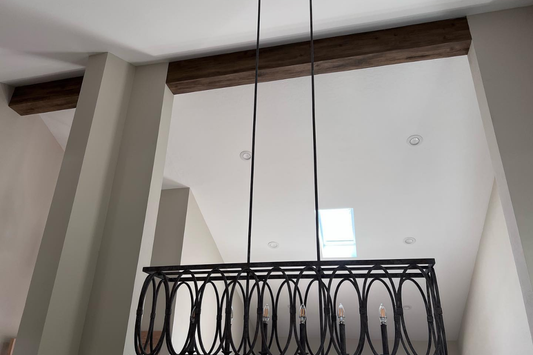
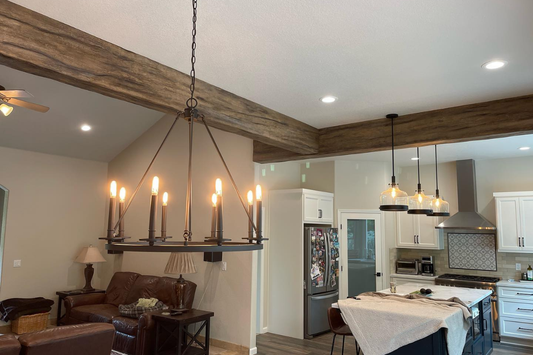
In contrast, an Elite Ceiling Designs faux wood beam of the same size weighs approximately 1 pound per linear foot. That same 20-foot beam weighs about 20 pounds. The total added weight for the entire room is around 100 pounds—less than a single solid wood beam.
In earthquake-prone regions, this difference is massive. It drastically changes the calculations for lateral bracing and shear strength. Heavy timber beams earthquake risk isn't just about the beam falling; it's about the stress that weight places on the connections and the walls supporting it.
What Happens to Decorative Elements During Seismic Shaking?
During an earthquake, a building experiences lateral (side-to-side) and vertical forces. Non-structural elements, like heavy cornices, concrete moldings, or solid wood beams, are subjected to these same accelerations.
If these heavy items are not anchored with extreme precision—which can be difficult in older framing—they become hazards. A heavy beam breaking loose is a catastrophic failure. Even if they don't fall, the inertia of heavy exterior architectural elements seismic hazard can cause them to crack, detach from stucco, or pull away from the framing, leading to costly repairs.
Lightweight materials have significantly less inertia. They move more easily with the building and exert far less strain on their fasteners. This reduces the risk of detachment and damage, keeping your family safer and your investment more secure.
What Makes a Material Earthquake-Safe in California?
There is no such thing as an "earthquake-proof" material, but there are certainly materials that perform better in seismic zones. In California, the best materials for safety are those that offer high strength-to-weight ratios and some degree of flexibility.
Earthquake-safe building materials California codes prioritize are those that don't add unnecessary stiffness or mass where it isn't needed. While structural steel and concrete are necessary for the skeleton of a building, using them for decoration is inefficient and risky in seismic zones.
Understanding Seismic Forces and Load Distribution
Seismic forces attack the weakest points of a structure. The higher the weight is located in the building, the greater the "whipping" effect. This is why a heavy tile roof is more dangerous than a composition shingle roof, and why heavy ceiling beams are riskier than lightweight ones.
When you use lightweight construction materials seismic zones require, you lower the building's center of gravity. This improves stability. It allows the structural system—the shear walls and foundation—to do its job without being overwhelmed by the momentum of heavy decorative features swinging above.
Why Reducing Non-Structural Weight Improves Overall Safety
Reducing non-structural weight is one of the most cost-effective ways to improve safety. You aren't just protecting the decorative element; you are protecting the whole house.
If you are planning a renovation or a new build, your engineer will calculate the "dead load" of the building. By specifying seismic code compliant architectural materials like high-density foam instead of stone or solid wood, you lower that dead load. This might allow you to use less aggressive shear walling or avoid expensive steel moment frames, saving money on the structural budget while actually increasing safety.
Why Lightweight Beams Make Sense for Seismic Retrofit Projects
The Bay Area has a beautiful inventory of historic and mid-century homes. Unfortunately, many of these were built before modern seismic codes were established. Retrofitting these homes is a major industry here.
When tackling a retrofit, the goal is often to "do no harm." You want to improve the look of the home without overstressing the aging frame. This is where lightweight beams for seismic retrofit projects shine.
Retrofitting Historic Bay Area Homes Without Adding Structural Load
Imagine owning a 1920s bungalow in Oakland. You want to add the look of exposed timber trusses to the living room to match the period style. The existing ceiling joists were sized for plaster and lath, not for holding up thousands of pounds of new solid oak timbers.
To install real wood, you would likely need to tear open the ceiling, sister new joists, and perhaps even upgrade the footings to carry the point loads. It turns a cosmetic upgrade into a major structural overhaul.
By choosing retrofit materials Bay Area contractors prefer—like Elite Ceiling Designs beams—you bypass that structural nightmare. You can install the look of heavy timber directly over the existing drywall or plaster. The weight is negligible, meaning the old framing can easily handle it without reinforcement.
Preserving Architectural Character While Improving Safety
Preservation doesn't have to mean using the exact same materials they used 100 years ago. It means preserving the intent and the visual character.
We work with many designers who are tasked with restoring the grandeur of old estates or adding character to mid-century modern homes. They choose our products because they can replicate the texture, grain, and scale of historic wood or concrete without the historic liability.
This approach aligns perfectly with seismic renovation materials California standards. You get the visual gravity of a heavy beam, but the physical reality is light and safe. It preserves the charm of the neighborhood while acknowledging the seismic reality of our geology.
Faux Beams for Earthquake Zones: A Safer Alternative to Solid Timber
At Elite Ceiling Designs, our products are engineered for reality. We simulate the look of wood, stone, and concrete using high-density polyurethane. This material is uniquely suited for faux beams for earthquake zones.
It isn't just about being light; it's about being durable and predictable. Unlike wood, which can rot, twist, check, or be eaten by termites—all of which weaken its connection to the structure—polyurethane remains stable.
High-Density Polyurethane vs. Solid Wood in Seismic Conditions
Solid wood is an organic material. It changes with humidity and temperature. Over time, heavy solid beams can shrink, causing the bolts holding them to loosen. In an earthquake, a loose connection is a failed connection.
High-density polyurethane is a closed-cell material. It is impervious to moisture and temperature fluctuations. Once it is installed, it stays dimensionally stable. This means the anchors and adhesives used to secure it remain tight and effective year after year.
When you compare polyurethane beams seismic zones applications against solid wood, the maintenance factor is also huge. You aren't climbing up on a ladder to inspect for dry rot or tightening bolts. The material is inert and consistent.
Strength, Durability, and Reduced Structural Demand
Our beams are strictly decorative, meaning they don't carry the roof load. However, they are incredibly durable. They resist impact and don't degrade like organic materials.
The key benefit, again, is the reduced structural demand. By using Faux Wood Beams, you free up the structural capacity of your home. You aren't "spending" your load limits on decoration. This is a smarter way to build in California, allowing your structural budget to go toward things that actually keep the building standing, like better shear paneling or foundation upgrades.
Seismic Considerations for Bay Area Remodels and Additions
Remodeling in the Bay Area is complex. You are dealing with strict Title 24 energy requirements, local planning commissions, and stringent seismic codes.
If you are adding a second story or extending a living room, every pound counts. Engineers are often fighting to keep shear wall lengths manageable so you can still have big windows and open floor plans.
Working Within California’s Seismic Standards
California’s building codes are some of the strictest in the world, and for good reason. When you apply for a permit for a Bay Area remodel seismic safety is reviewed closely.
If you specify heavy architectural stone or massive wood beams, the engineer has to account for that seismic mass. This often triggers a requirement for more steel, more plywood, and bigger footings.
By specifying Elite Ceiling Designs products, you are specifying Bay Area construction materials that help you breeze through these calculations. Because our products are so light, they often fall below the threshold that would trigger additional structural engineering for dead loads. This simplifies the permitting process and lowers construction costs.
If you are working on a project in San Francisco, Marin, or the Peninsula, check out our Bay Area location page to see how we've helped other local homeowners navigate these challenges with style.
Designing for Safety Without Compromising Style
The fear with "safe" or "lightweight" materials is often that they will look cheap or fake. In the past, that might have been true. But manufacturing technology has evolved.
We cast our beams from molds made of real, distressed timber. Every grain pattern, knot, and tool mark is captured in the high-density foam. Once stained or painted, they are virtually indistinguishable from the real thing, even from a few feet away.
This allows designers to create dramatic, heavy-looking interiors—think cathedral ceilings with massive trusses—without the "heavy" risks. You can design for the "wow" factor without worrying about the "ow" factor of an earthquake.
Installation Matters: Lightweight Materials Still Need Proper Mounting
Just because a beam is lightweight doesn't mean you can stick it up with double-sided tape. In an earthquake, everything moves. Proper installation is critical to ensure that even lightweight elements stay exactly where they are supposed to be.
Beam installation seismic zones requires specific techniques. While the loads are lighter, the shaking is still violent.
Proper Anchoring in Seismic Environments
Installing Elite Ceiling Designs beams generally involves mounting a wood cleat or blocking to the ceiling joists, and then securing the foam beam to that cleat with screws and adhesive.
In seismic zones, hitting the framing is non-negotiable. You cannot rely on drywall anchors for architectural features, even light ones. The vibration of an earthquake can crumble drywall gypsum, causing anchors to pull out.
We recommend screwing the mounting cleats directly into the ceiling joists or trusses. Because the beam itself is light, the shear strength of standard screws is more than sufficient to hold it during a seismic event, provided they are bit into solid wood. This creates a mechanical bond that rides out the shaking securely.
Why Professional Installation Protects Your Investment
While our products are DIY-friendly, we always recommend professional installation for large or complex projects, especially in earthquake country.
A professional installer understands California beam installation standards. They know how to find the framing, how to bridge spans correctly, and how to use industrial-grade adhesives that act as a secondary safety measure.
Proper installation ensures that your beams don't just look good, but act as a cohesive part of the ceiling assembly. If you are looking for peace of mind, consider using our Installation Services to ensure the job is done right.
Choosing Lightweight Architectural Materials for Seismic Zones
Not all foam or faux products are created equal. When shopping for best lightweight architectural materials seismic zones, you need to look beyond just the weight. You need quality, density, and manufacturer support.
Durability, Moisture Resistance, and Code Compatibility
In the Bay Area, we have microclimates. One day it's foggy and damp; the next it's dry and hot. Materials need to handle moisture without warping or rotting.
Look for high-density polyurethane. Low-density foams (like styrofoam) are too soft and easily damaged. High-density foam feels substantial—like pine wood—to the touch. It holds screws, sands easily, and takes paint or stain beautifully.
Also, check for fire ratings. While we are talking about seismic safety, fire safety often goes hand-in-hand in California building codes. Ensure the product you choose meets the necessary flame spread ratings for interior or exterior use.
Balancing Structural Responsibility with Design Vision
The ultimate goal of any build is balance. You want a home that is safe, beautiful, and durable.
Choosing lightweight materials is an act of balancing structural responsibility with design vision. You are acting responsibly by not overloading your home's frame. You are acting creatively by not letting structural limitations dictate your style.
Whether you are looking for decorative beams California climate ready, or corbels and trusses for a commercial project, the choice to go lightweight is a choice for longevity.
Building Smarter in Earthquake Country
We can't stop earthquakes from happening. But we can choose how our buildings respond to them.
Building smarter in earthquake country means evolving past the idea that "heavier is better." In a seismic zone, lighter is safer. Lighter is smarter.
By choosing Elite Ceiling Designs’ lightweight architectural products, you are making a conscious decision to reduce the seismic load on your home. You are choosing materials that are easy to retrofit into older Bay Area properties. You are choosing a solution that respects the power of nature without sacrificing the beauty of architecture.
Design and safety are not mutually exclusive. With the right materials, they work hand in hand to create homes that stand the test of time—and the test of the earth.
Covering or upgrading a ceiling beam is one of those projects where the right material makes all the difference. If you want something that looks like real wood without the weight, maintenance, or installation complexity, foam beams are usually the most practical option.
You can request a custom quote for your project or contact our team . to talk through your space and get a clear direction before you start.