How to Choose the Right Beam Size for Your Ceiling

Decorative ceiling beams possess a unique power to transform a room. They can introduce warmth, create architectural interest, and define the style of a space, turning a plain ceiling into a captivating focal point. Whether you're aiming for a rustic farmhouse look, a modern minimalist vibe, or a grand, traditional feel, the success of your design hinges on one crucial detail: selecting the right beam size. Choosing beams that are too small can look awkward and insignificant, while beams that are too large can overwhelm the room and make it feel cramped.
Finding the perfect beam size for your ceiling is a blend of art and science. It involves understanding principles of scale, proportion, and visual weight. This comprehensive guide will walk you through everything you need to know to make an informed decision. We'll explore established design rules for depth and spacing, discuss how room dimensions influence beam width, and examine the concept of visual weight. By the end, you will have the confidence to select the ideal decorative beam dimensions that not only fit your space but elevate it.
This guide focuses on high-quality, lightweight faux wood beams, like those offered by Elite Ceiling Designs, which provide the authentic look of real wood without the structural limitations. This allows you to focus purely on aesthetics, giving you the freedom to choose the perfect size to achieve your vision without worrying about engineering or ceiling reinforcement.
The Foundation: Understanding Scale and Proportion
Before we dive into specific formulas and measurements, it's essential to grasp the core design principles of scale and proportion. These concepts are the foundation for choosing the right beam size and will guide all your decisions.
- Scale refers to the size of an object in relation to its surroundings. In this case, it's the size of your ceiling beams relative to the size of your room—its length, width, and particularly its height. A massive, 12-inch beam might look perfectly at home in a grand hall with 20-foot ceilings but would feel oppressive in a small bedroom with an 8-foot ceiling.
- Proportion refers to the relationship between the different elements of a design. This includes the relationship between the beam's height and its width, as well as the proportion of the beams to the spaces between them (ceiling beam spacing). A well-proportioned design feels balanced, harmonious, and visually pleasing.
Getting the scale and proportion right is the difference between a professional, intentional design and one that feels "off." The rest of this guide provides the tools and rules of thumb to help you master these concepts for your project.
Ceiling Height and Beam Depth: The "One-Twelfth" Guideline
One of the most critical relationships in ceiling design is between the height of your ceiling and the depth (or height) of your beams. A common and highly effective rule of thumb is the "One-Twelfth Rule."
The Rule: The depth of your decorative beams should be approximately 1/12th of your ceiling height.
This guideline provides an excellent starting point for determining an appropriately scaled beam depth that feels substantial without being overpowering.
Applying the Rule to Different Ceiling Heights
Let's break down how this formula works for common ceiling heights:
- For a standard 8-foot (96-inch) ceiling:
- 96 inches / 12 = 8 inches
- Ideal Beam Depth: 8 inches. You could consider beams in the 6-inch to 8-inch depth range. A 6-inch beam would feel more subtle, while an 8-inch beam would make a stronger statement.
- For a 9-foot (108-inch) ceiling:
- 108 inches / 12 = 9 inches
- Ideal Beam Depth: 9 inches. Beams with a depth of 8 to 10 inches would work beautifully here.
- For a 10-foot (120-inch) ceiling:
- 120 inches / 12 = 10 inches
- Ideal Beam Depth: 10 inches. This height can easily accommodate a substantial 10-inch beam, creating a noticeable architectural feature.
- For a 12-foot (144-inch) or vaulted ceiling:
- 144 inches / 12 = 12 inches
- Ideal Beam Depth: 12 inches or more. With higher ceilings, you have more freedom to use larger, more dramatic beams. A 12-inch beam provides a strong visual anchor, and for very high vaulted ceilings, you might even consider depths of 14 or 16 inches for a truly grand effect.
Flexibility and Adjustments
The One-Twelfth Rule is a guideline, not an unbreakable law. You can adjust it based on the specific atmosphere you want to create.
- For a Cozier, More Rustic Feel: You might choose a beam that is slightly deeper than the rule suggests. The larger beam will have more visual weight, making the ceiling feel a bit lower and the room more intimate. For an 8-foot ceiling, choosing an 8-inch or even a 10-inch deep beam can enhance a rustic farmhouse or lodge style.
- For a Lighter, More Modern Look: You might opt for a shallower beam. A 6-inch deep beam on a 9-foot ceiling can provide a clean, architectural line without dominating the space, which is perfect for contemporary or transitional designs.
Always consider the overall style of your home. A historic Tudor or Spanish-style home might call for heavier, deeper beams, while a modern coastal home would benefit from lighter, less imposing dimensions.
Room Size and Beam Width: Achieving Visual Balance
While beam depth is tied to ceiling height, beam width is more closely related to the overall size and scale of the room, specifically its length and width. A long, narrow room and a large, open-concept space have different requirements for achieving visual balance. There isn't a strict mathematical formula for width like there is for depth, but there are strong guiding principles.
The Relationship Between Beam Depth and Width
Often, the depth and width of a beam are similar, creating a square or near-square profile (e.g., 6" x 6", 8" x 8", 10" x 8"). This is a classic look that works in most applications. However, you can create different effects by using a rectangular profile.
- Deeper than Wide (e.g., 6" wide x 8" deep): This profile emphasizes height and can make the ceiling feel taller. It mimics the look of structural joists and works well in designs that aim for a more authentic, construction-based appearance.
- Wider than Deep (e.g., 10" wide x 6" deep): This creates a "plank" or "band" effect. A wider, shallower beam can feel more modern and can be used to create broad visual lines across a ceiling without sacrificing too much headroom.
For most residential applications, a beam that is as wide as it is deep, or slightly wider, is a safe and aesthetically pleasing choice. For example, if your ceiling height suggests an 8-inch deep beam, a width of 8 to 10 inches will likely look well-proportioned.
Sizing for Large, Open-Concept Rooms
In a large, open-plan living area or a great room, small beams will look undersized and lost. The expansive space requires beams with enough mass to make a visual impact.
- Go Wider: For rooms wider than 20 feet, consider beams that are at least 8 or 10 inches wide. In very large spaces, 12-inch or 14-inch wide beams are often necessary to match the scale of the room.
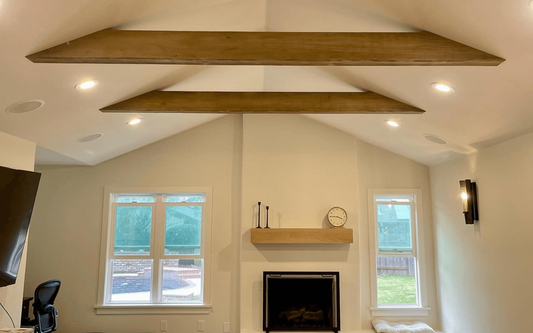
- Central Ridge Beams: In vaulted great rooms, the central ridge beam should be the largest in both width and depth to serve as a powerful anchor for the entire design.
Sizing for Smaller or Narrower Rooms
In smaller spaces like bedrooms, dens, or hallways, overly wide beams can feel bulky and make the room seem smaller.
- Prioritize Proportion: In a 12-foot wide bedroom, a 6-inch wide beam is often sufficient. An 8-inch wide beam would create a more robust look, but a 12-inch beam would likely be too much.
- Consider the Layout: If you're running beams across the shorter dimension of a long, narrow room, you can use slightly wider beams to create a visual illusion that "pushes" the walls apart, making the room feel wider.
Proper Ceiling Beam Spacing: The 4-to-8-Foot Rule
Once you've determined the ideal dimensions for your beams, the next question is how far apart to place them. The ceiling beam spacing is crucial for creating a sense of rhythm and balance. Placing them too close together can make the ceiling look cluttered and busy, while spacing them too far apart can diminish their impact and make the design feel sparse.
A widely used and effective guideline is the "4-to-8-Foot Rule."
The Rule: Space your decorative ceiling beams 4 to 8 feet apart on center.
"On center" means the measurement is taken from the center of one beam to the center of the next.
Finding Your Ideal Spacing
The optimal spacing within this 4-to-8-foot range depends on several factors:
- Beam Size: Larger, more massive beams should be spaced further apart. If you're using substantial 10" x 10" beams, a spacing of 6 to 8 feet will give them room to breathe and allow each one to stand out as a significant architectural element. Smaller, 6" x 6" beams can be placed closer together, perhaps 4 to 5 feet apart, to create a more textured, rhythmic effect, like that of traditional ceiling joists.
- Ceiling Height: High ceilings can accommodate wider spacing. With more vertical space, the eye can take in a larger area, so beams spaced 7 or 8 feet apart will still feel connected. On lower, 8-foot ceilings, a tighter spacing of 4 to 6 feet often works better to create a cohesive look without making the room feel sectioned off.
- Room Layout and Fixtures: Plan your beam spacing around other ceiling elements like light fixtures, skylights, or ceiling fans. You may want to center a beam over a kitchen island or dining table, or space beams so that pendant lights can be hung perfectly in the bays between them. It's often best to start your layout from the center of the room and work outward to ensure a symmetrical and balanced design.
How to Calculate Your Spacing
Here’s a simple method to plan your layout:
- Measure the Room: Measure the length of the ceiling area where the beams will be installed.
- Choose a Target Spacing: Decide on a desired spacing (e.g., 5 feet).
- Do the Math: Divide the room length by your target spacing. For a 19-foot room with a target spacing of 5 feet: 19 / 5 = 3.8. This means you'll have about 4 bays (the spaces between beams). Having 4 bays requires 3 beams.
- Adjust for Even Spacing: To space 3 beams evenly in a 19-foot room, you would divide the space into 4 equal sections: 19 feet / 4 = 4.75 feet, or 4'9". You would place the center of each beam at the 4'9", 9'6", and 14'3" marks along the wall. This ensures a perfectly symmetrical layout.
Taking the time to map out your ceiling beam spacing on paper first will save you a lot of headaches during installation and ensure a professional-looking result.
Visual Weight: Creating Atmosphere with Beam Dimensions
"Visual weight" is a design concept that refers to the perceived heaviness of an object. It's not about the actual physical weight—especially with lightweight faux beams—but about how much an element commands attention and impacts the feel of a room. The decorative beam dimensions you choose are the primary driver of visual weight.
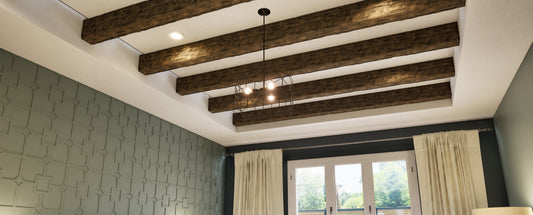
- High Visual Weight: Large, dark-colored beams with a rugged, Hand Hewn texture have high visual weight. They are bold, dramatic, and make a strong statement. This look is perfect for creating a cozy, rustic, or grand atmosphere. In a room with high ceilings, heavy visual weight can help ground the space and make it feel more intimate and inviting.
- Low Visual Weight: Small, light-colored beams with a smooth or subtle Resawn texture have low visual weight. They are understated, airy, and add architectural interest without dominating the room. This is ideal for modern, minimalist, or coastal designs where the goal is to create a bright, open, and uncluttered feel.
Think about the mood you want to create:
- Cozy and Rustic (Lodge, Farmhouse): Opt for higher visual weight. Choose deeper and wider beams (e.g., 8"x10" or 10"x10") in a medium to dark wood finish.
- Grand and Traditional (Tuscan, Tudor): This style also calls for high visual weight, often with the largest and most substantial beams a room can handle.
- Bright and Airy (Coastal, Modern): Go for lower visual weight. Choose shallower and narrower beams (e.g., 6"x6" or 8"x6") and consider finishing them in a light natural wood tone or even painting them white to match the ceiling.
Technical Details: The Advantage of U-Shaped Beams
A key practical advantage of modern faux wood beams is their construction. Unlike solid wood, they are manufactured as three-sided, U-shaped hollow profiles. This design is fundamental to their benefits and ease of installation, and it's a factor to be aware of when planning.
Why the Hollow Profile is a Game-Changer
- Easy Installation: The hollow channel allows the beam to be fitted easily over mounting blocks that have been screwed into the ceiling joists. This is the core of the simple installation process, which you can learn more about on our installation and help page.
- Concealing Wires and Pipes: The hollow interior is perfect for hiding unsightly elements. You can run speaker wire, electrical conduit for recessed lighting, or even small plumbing lines inside the beam, creating a clean, seamless ceiling.
- Lightweight Nature: Being hollow is what makes the beams so incredibly lightweight, eliminating the need for any structural reinforcement.
Appearance vs. Reality
From the ground, a properly installed U-shaped beam is indistinguishable from a solid timber. The open side fits flush against the ceiling, and the three visible sides provide the complete look and feel of a solid piece of wood. When selecting your beam size for a ceiling, you are choosing the exterior dimensions of this U-shape. An "8x10" beam will measure 8 inches deep and 10 inches wide on the outside, creating the visual mass of a solid 8x10 timber.
The hollow nature gives you all the aesthetic benefits without any of the physical or structural drawbacks of solid wood, a core benefit of the services we provide.
Putting It All Together: A Step-by-Step Selection Process
Let's consolidate everything into a practical, step-by-step process for choosing your perfect beam size.
- Define Your Style: Before you measure anything, decide on the feeling and aesthetic you want to achieve. Rustic? Modern? Transitional? This will influence all subsequent decisions about size and texture.
- Measure Your Space: Get accurate measurements of your room's length, width, and ceiling height.
- Determine Beam Depth: Use the One-Twelfth Rule as your starting point. Divide your ceiling height in inches by 12. Adjust this number up or down slightly based on your desired visual weight.
- Determine Beam Width: Consider the overall scale of your room and the depth you've chosen. For most applications, a width equal to or slightly larger than the depth will work well. Go wider for larger rooms and narrower for smaller spaces.
- Plan Your Spacing: Use the 4-to-8-Foot Rule to decide on your ceiling beam spacing. Calculate the exact placement for a symmetrical layout. Remember to space larger beams further apart.
- Get a Quote: Once you have your ideal dimensions and know the number and length of the beams you need, you can easily get a precise cost estimate. For a personalized price for your project, submit your specifications for a foam beams quote.
Conclusion: Design with Confidence
Choosing the right beam size for your ceiling is the most important step in creating a stunning and professional-looking architectural feature. By following established design principles like the One-Twelfth Rule for depth and the 4-to-8-Foot Rule for spacing, you can demystify the process and move forward with confidence. Remember to consider the overall scale of your room, the visual weight you want to create, and the specific style you are aiming for.
Because high-quality faux wood beams are lightweight and versatile, you have the creative freedom to focus entirely on getting the aesthetics right. You can achieve the dramatic effect of massive, heavy timbers without any of the structural challenges or exorbitant costs. The result is a transformed space that reflects your personal style and adds lasting value and character to your home.
Ready to find the perfect beams for your project? Explore the variety of sizes and styles in our online shop and start planning your room's transformation today.