Farmhouse Modern vs. Mediterranean Architecture in Northern California

Northern California is a unique architectural landscape. Drive through the suburbs of Sacramento, the rolling hills of El Dorado Hills, or the established neighborhoods of the Bay Area, and you won't see just one style. You'll see a rich tapestry of design history. However, two distinct styles have risen to the top of the wish lists for homeowners planning custom builds or major renovations: the crisp, nostalgic Modern Farmhouse and the warm, timeless Mediterranean.
Choosing between these two isn't just about picking a roofline or a paint color. It’s about deciding how you want your home to feel and how it will interact with the Northern California landscape. Both styles rely heavily on architectural details—specifically exposed beams and timber work—to tell their story, but they speak very different languages.
Two Distinct Directions in Northern California Home Styles
If you are planning a project in the Greater Sacramento area or the foothills, you are likely weighing these two options. Northern California home styles have evolved significantly over the last twenty years. We’ve seen a shift away from generic suburban tract design toward homes with distinct character and historical roots.
The Modern Farmhouse offers a connection to the region's agricultural past, but cleans it up for contemporary living. It’s sharp, bright, and linear. On the other hand, Mediterranean architecture (and its close cousin, Spanish Revival) nods to California’s climate and mission history. It is earthy, textured, and grounded.
Understanding the DNA of these popular home styles California residents love is the first step in making a choice you will be happy with for decades. It’s not just about what is trending on Pinterest right now; it’s about what fits the land and your lifestyle.
What Defines Modern Farmhouse Architecture?
The Modern Farmhouse isn't just a farmhouse. It’s a hybrid. It takes the practical, honest forms of traditional rural buildings—steep gables, simple rectangular footprints, metal roofs—and strips away the clutter. The result is a high-contrast, sophisticated look that feels fresh but familiar.
When we work with clients on modern farmhouse beams and exterior details, we notice a focus on verticality and simplicity. The clutter is gone. The ornamentation is minimal. The beauty comes from the repetition of simple forms.
Clean Lines with Rustic Accents
The defining feature of this style is the high-contrast palette. You often see white siding paired with black window frames and dark metal roofs. This creates a crisp backdrop. To prevent the house from feeling sterile or cold, designers introduce rustic wood elements.
This is where the architecture comes alive. A natural wood beam spanning a front porch or a set of reclaimed-style headers over the windows adds immediate warmth. In modern farmhouse exterior design, these wood accents aren't just decorative; they are essential for grounding the house and connecting it to the natural surroundings.
The Role of Exposed Beams in Farmhouse Modern Interiors
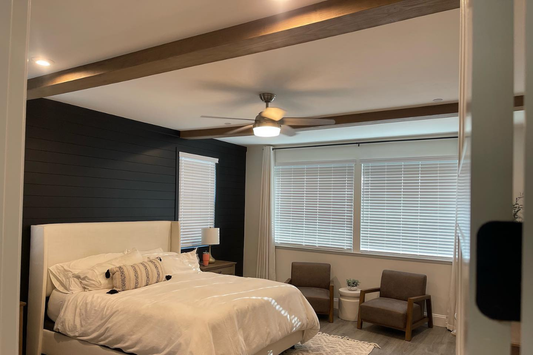
Step inside a Modern Farmhouse, and the volume creates the drama. These homes typically feature vaulted ceilings in the great room, kitchen, and primary suite. Without architectural detailing, these tall white rooms can feel like gymnasiums.
Exposed beams farmhouse style are the solution. They bring the ceiling down to a human scale. In this style, the beams are usually simple and linear. We rarely see heavy distressing or ornate carving here. Instead, homeowners opt for clean, hewn textures or wire-brushed finishes that highlight the grain without looking "old world." The beams are often arranged in simple trusses or a straightforward ridge-and-rafter pattern that emphasizes the pitch of the roof.
Exterior Beam Applications in Contemporary Farmhouse Homes
On the exterior, the beam work is equally restrained but impactful. You might see a simple timber truss in the peak of a gable, or straight columns supporting a porch overhang. The key is symmetry. Farmhouse architecture relies on balance.
Farmhouse modern ceiling ideas often extend to outdoor living spaces. Covered patios are treated as extensions of the living room, with the same beam treatments continuing from inside to outside. This blurs the line between the interior and the Northern California outdoors, making the home feel larger and more connected to the property.
What Defines Mediterranean Architecture?
While the Modern Farmhouse is all about crisp lines, Mediterranean architecture is about depth, shadow, and mass. This style is incredibly well-suited to the Sacramento and Central Valley climate, mimicking the sun-drenched regions of Italy and Spain.
Mediterranean homes feel permanent. They use stucco, stone, and tile to create a sense of solidity. Where the Farmhouse is light and airy, the Mediterranean home is grounded and protective. The walls are thick, the eaves are deep, and the details are rich.
Arches, Texture, and Architectural Depth
If the rectangle is the shape of the Farmhouse, the arch is the shape of the Mediterranean. You see it in doorways, windows, and loggias. This softness requires a different approach to detailing.
Mediterranean style ceiling beams play a huge role here. In these homes, the ceilings are often flat or subtly vaulted, and the beams are used to create a heavy, rhythmic texture. Dark, rich wood tones are common, providing a striking contrast against warm, cream-colored plaster walls. The wood looks older, heavier, and more "worked" than in modern styles.
Ceiling Beams as a Core Mediterranean Design Element
In a Mediterranean great room or kitchen, the ceiling is often the focal point. We frequently install heavy grid patterns (coffered ceilings) made of faux timber, or closely spaced parallel beams that mimic the support structure of an old adobe.
Exposed beams Mediterranean homes rely on are typically wider and deeper. They need to stand up to the visual weight of the stucco and stone. A thin, delicate beam would disappear in a room with travertine floors and wrought iron chandeliers. The texture here is aggressive—deep checking, hand-hewn marks, and dark stains that look like they’ve aged for centuries.
Exterior Corbels and Beam Tails
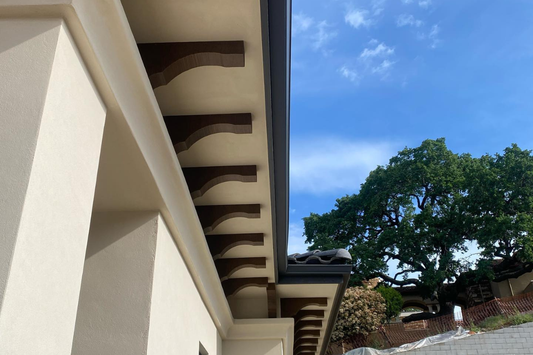
One of the most distinctive features of Spanish Mediterranean home details is the use of corbels and rafter tails. Walk around a classic Spanish Revival home in Land Park or East Sacramento, and you’ll see exposed beam ends poking out from under the roofline.
These "tails" give the roof a floating appearance and add a layer of shadow and detail to the eaves. Often, decorative corbels are placed under window sills or balconies. These elements are purely ornamental today, but they mimic the structural supports of traditional masonry buildings. They add a level of craftsmanship and history that plain stucco simply cannot achieve.
Structural Feel: Light and Linear vs. Textured and Layered
When choosing architectural style California projects demand, you are really choosing a structural "vibe." Do you want your home to feel light, precise, and engineered? Or do you want it to feel heavy, hand-crafted, and organic?
This difference dictates how we design the beam layouts for our clients. It affects the size of the beam, the spacing, and the finish.
Beam Scale and Profile Differences
In farmhouse modern vs Mediterranean architecture, scale is the biggest differentiator.
For a Modern Farmhouse, we might specify a 6x8 or 8x8 beam. It feels substantial but not overwhelming. The goal is to draw a line in space.
For a Mediterranean project, we are often looking at 10x12 or even 12x14 beams. We want mass. We want the beams to feel like they are holding up a heavy clay tile roof (even if they are lightweight foam). The profiles are often more irregular in Mediterranean designs, mimicking logs that were hand-adzed into shape, whereas Farmhouse beams look like they came from a turn-of-the-century sawmill—rough, but square.
How Ceiling Height Influences Style Choice
Ceiling height also plays a role. Modern Farmhouses often have steep 12:12 roof pitches, creating soaring cathedral ceilings. Here, transitional California home design principles apply—we use trusses to lower the visual ceiling and create intimacy.
Mediterranean homes often have lower roof pitches (4:12 or 6:12). The ceilings might be 10 or 12 feet high and flat. In this setting, the beams act as a texture on the ceiling plane rather than a 3D structure floating in space. They create a cozy, enclosed feeling that is very different from the airy openness of the Farmhouse.
Material Considerations for Both Styles
Regardless of which style you choose, the challenge of building with real wood remains the same. Solid timber is heavy, expensive, and prone to warping, twisting, and checking. In the hot, dry summers of Sacramento and the damp, foggy winters of the Bay Area, real wood moves.
This movement can crack drywall, pop finishes, and create unsightly gaps in your carefully designed ceiling.
Achieving Solid Timber Aesthetics Without Structural Bulk
This is where lightweight decorative beams California homeowners choose make a massive difference. Elite Ceiling Designs beams are made from high-density polyurethane. We mold them from actual timber, so they capture every grain detail, knot, and tool mark of the real thing.
Whether you need the clean, wire-brushed look for a Farmhouse or the heavy, hand-hewn look for a Mediterranean villa, the material is the same. It weighs a fraction of real wood. This means you can install massive, heavy-looking beams on a standard ceiling without reinforcing the trusses or hiring a structural engineer.
Durability Considerations for Interior and Exterior Applications
For architectural beam materials comparison, durability is key. Real wood corbels and rafter tails on a Mediterranean exterior are notorious for dry rot. They are exposed to the elements and are difficult to maintain.
Our faux wood beams Northern California clients install are weatherproof. They don't absorb moisture. They don't attract termites. You can install a decorative rafter tail on a Mediterranean eave and never worry about it rotting out. Similarly, on a white Farmhouse exterior, you don't have to worry about the tannins in real wood bleeding through and staining your paint. The material is stable, inert, and permanent.
Which Style Works Best for Your Northern California Setting?
Context matters. A home should feel like it belongs in its neighborhood. While you can build whatever you like, certain styles resonate better in specific Northern California environments.
Urban Infill and Historic Neighborhoods
If you are building an ADU or renovating a home in a dense neighborhood like Midtown Sacramento or Rockridge in Oakland, the Modern Farmhouse style often works well. Its vertical massing fits narrow lots, and its clean lines blend with both historic Victorians and industrial lofts.
However, if you are in a neighborhood established in the 1920s or 30s, like parts of Palo Alto or East Sac, a Mediterranean renovation might respect the existing streetscape more effectively. Northern California custom home design is often about being a good neighbor while still getting the home you want.
Suburban and Vineyard Properties
Move out to the suburbs—Granite Bay, Roseville, Walnut Creek—and you have more room to breathe. Here, both styles thrive.
However, in the vineyard properties of Napa, Sonoma, and the Sierra Foothills, the Farmhouse style has a natural advantage. It echoes the agricultural history of the land. The simple forms look beautiful against rows of vines.
Conversely, on a hillside property with oak trees and rocky outcroppings, the earth tones and low profile of a Mediterranean home can settle into the landscape beautifully, feeling like an extension of the hill itself.
Blending Elements for a Transitional Approach
We are seeing a rise in "Transitional" architecture that borrows from both. You might see a home with the clean white stucco of a modern build but the clay tile roof of a Spanish home. Or a Farmhouse shape that uses warm, Mediterranean stone instead of siding.
In these Mediterranean homes Northern California hybrids, the beam choices become critical. They bridge the gap. A cleaner, less rustic beam in a Mediterranean home can modernize it. A darker, heavier beam in a Farmhouse can add gravity.
Design Flexibility: Custom Beam Options for Both Styles
At Elite Ceiling Designs, we don't believe in "one size fits all." Because we manufacture everything in-house, we can tailor the texture and color to fit your specific vision.
Custom Beam Design California
If you are leaning toward Farmhouse but worry it feels too cold, we can create a custom beam design California style that adds warmth. We might suggest our "Sandblast" texture—it’s clean but has organic character. We can finish it in a "Driftwood" or "Light Walnut" stain that keeps things airy.
Beam Texture Options for Farmhouse
For beam texture options farmhouse projects, less is usually more. We avoid deep gouges. We focus on the grain pattern. We can create box beams that wrap structural steel or plumbing, hiding the ugly necessity of modern construction inside a beautiful architectural feature.
Mediterranean Beam Finish Options
For Mediterranean beam finish options, we get to have fun with character. Our "Hewn" or "Heavy Sandblast" textures are perfect here. We can apply rich "Dark Walnut" or "Espresso" stains that anchor the room. We can even add decorative straps that mimic the iron hardware used in old-world construction. This level of architectural beam customization allows you to dial in the exact level of rusticity your home needs.
Farmhouse Modern vs. Mediterranean: Making a Confident Choice
Deciding between these two iconic styles is tough. Both offer beauty, value, and a lifestyle that fits Northern California perfectly.
The Modern Farmhouse offers a clean slate—a bright, optimistic, and organized way of living. It celebrates structure and simplicity. Mediterranean architecture offers a warm embrace—a connection to history, texture, and the earth. It celebrates craftsmanship and permanence.
Ultimately, the success of either style depends on the execution. A Farmhouse without beams feels sterile. A Mediterranean home without texture feels like a taco shop.
Choosing home style California projects requires attention to detail. The beams, the corbels, the trusses—these are the elements that give the home its soul. Whether you want the crisp lines of a farmhouse modern vs Mediterranean architecture's deep shadows, Elite Ceiling Designs has the solution.
Our lightweight, high-density polyurethane beams allow you to execute these designs without the headaches of heavy timber. You get the look you fell in love with, with the durability and ease of installation that modern construction demands. Your Northern California home deserves architectural details that are as resilient as they are beautiful.
If you're planning a remodel or new build, the details you choose will shape the entire space. Ceiling beams can either blend in or become a defining architectural feature depending on how they’re designed.
Browse our faux beam styles and finishes or reach out to our team to plan a design that fits your home and location.