Ceiling Design Trends for 2027
Key Takeaways
- This is a point of view, not survey data. The useful half of any trends piece is what is now overexposed.
- Fewer and larger beams is the clearest shift — three deep members where a room once took six shallow ones.
- Ceiling changes are increasingly marking functional zones in open plans, doing the job a wall used to do.
- With stains converged on a narrow warm range, texture is where the design decision has moved — and texture has to be lit for.
- Tightly spaced small beams across a whole ceiling is now the most common way to date a room.
- Layout is what dates and cannot be changed. Finish is reversible. Spend the caution on the layout.
How to read a trends piece, including this one
Worth saying up front: this is a considered point of view from a company that fabricates and installs decorative ceilings, not survey data. Nobody has a dataset that reliably predicts what people will want next year, and pieces that imply otherwise are usually restating what was already popular.
So this is written to be useful in a specific way. Rather than a list of looks to copy, it separates three things: what has stopped being a trend because it simply became normal, what is genuinely shifting, and what is now overexposed enough that choosing it in 2027 will date the room. The last section is the one that matters most if you are spending money on something that stays up for twenty years.
Our 2026 design guide covers where this started. This is what has moved since.
What is no longer a trend, because it won
Three things from the last few years have stopped being choices and become defaults. That is not a criticism — it is what happens when something works.
- Warm wood tones over grey. The grey era is thoroughly over. Warm walnut, natural oak and mid-brown stains are now the baseline expectation rather than a direction, which means choosing one is no longer a statement and no longer dates a room either way.
- The ceiling as a designed surface. Five years ago a treated ceiling was a feature. It is now simply what a considered room has, and a flat white ceiling in an otherwise detailed space reads as unfinished rather than restrained.
- Lightweight over structural. Nobody needs convincing any more that a decorative beam is a legitimate way to get timber character. The conversation has moved entirely to which profile and which finish.
Where 2027 is actually moving
Fewer, larger members
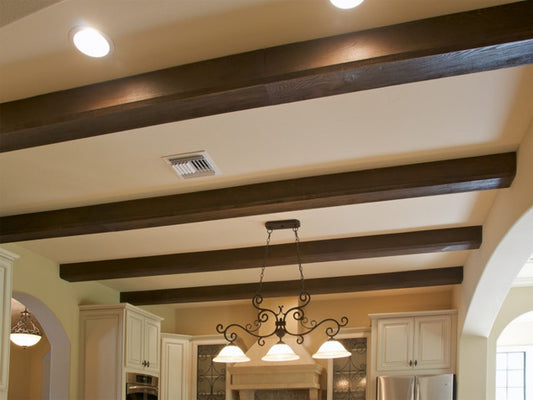
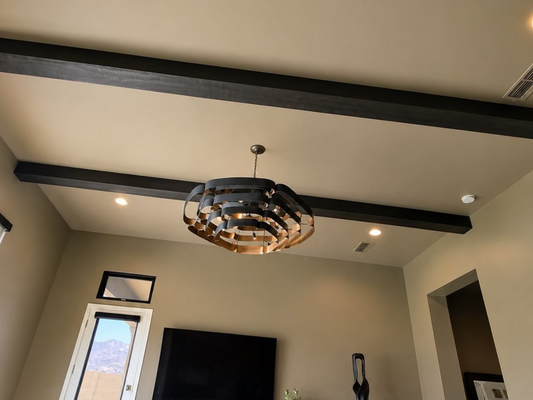
The clearest shift, and it has been building for two years. Where a room might once have taken six beams at close centers, the same room now takes three that are considerably deeper. The effect is calmer and more architectural, and it reads as structure rather than as decoration.
It also changes the economics in a way worth knowing: fewer, larger beams is not automatically cheaper than more, smaller ones, because a deeper profile costs more per foot and the handling is different. Ask for both priced if you are undecided — see pricing and quotes.
Ceilings that follow the plan, not the room
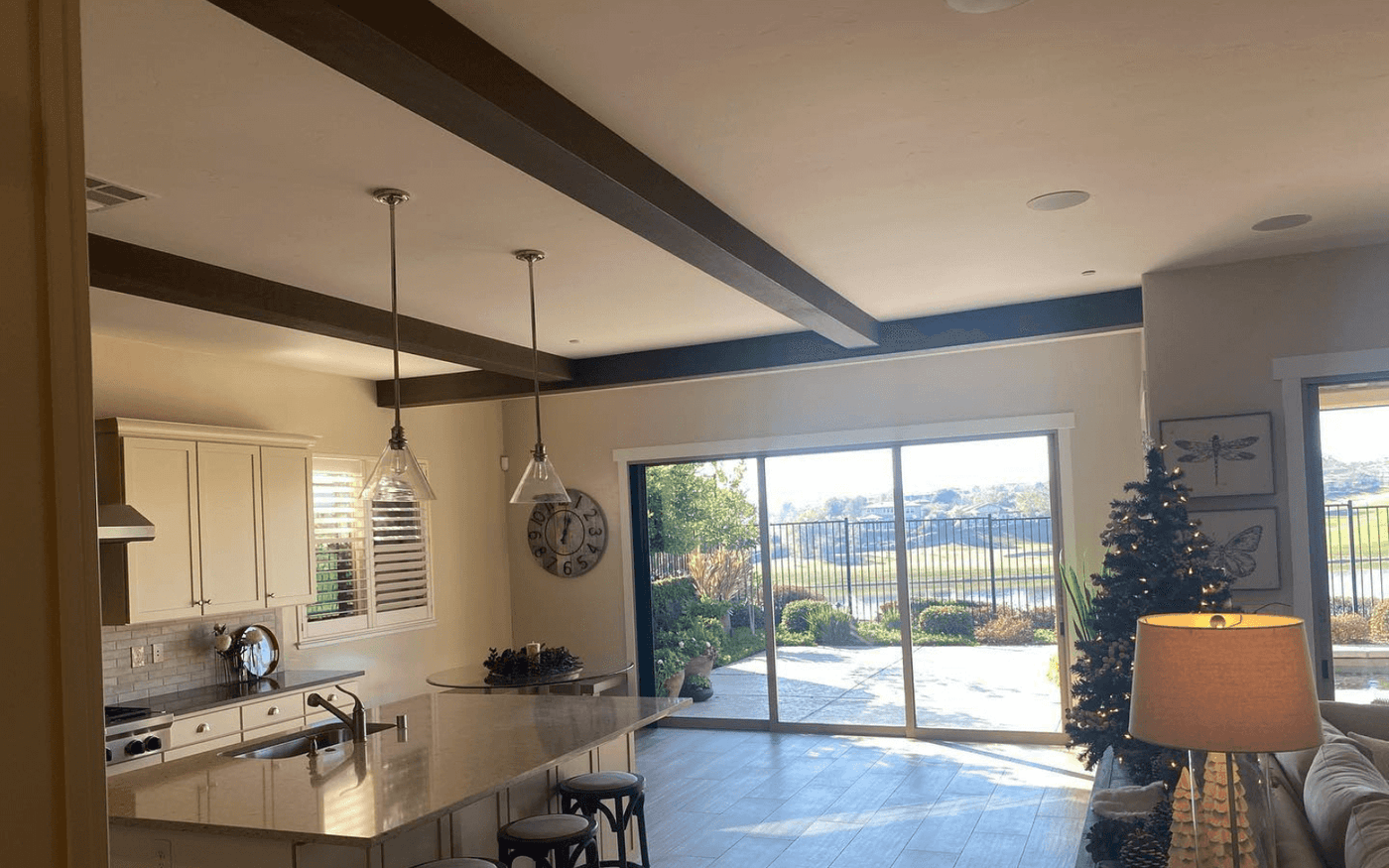
In open plans, the interesting work is happening where a ceiling change marks a functional boundary rather than a wall. A beam grid over the kitchen, a flat plane over the living area, a dropped section over a dining table. The boundary does the job a wall used to, without closing anything in.
This is the single most useful idea in current ceiling design and it applies just as much in offices — see office and open-plan ceiling design.
Texture doing the work instead of color
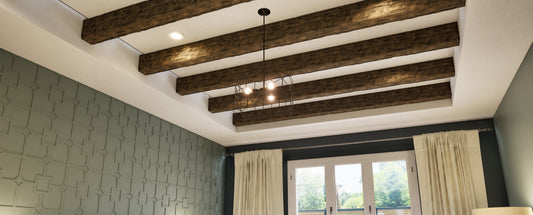
As stains converge on a fairly narrow warm range, the differentiation has moved to surface. Hand-hewn, resawn, rough-sawn and axed profiles in similar tones look substantially different from one another under the same light, and increasingly that is where the design decision is being made.
Texture only pays off if it is lit for. Light striking a textured beam straight on flattens it completely; light grazing along the face is what makes it visible. That is a lighting decision taken at the same time as the beam decision, not afterwards — see how to plan lighting for a beamed ceiling and beam textures and finishes.
Painted and tonal beams
Not everything is stained timber any more. Beams painted to match the ceiling — so the room reads as shape and shadow rather than as contrast — have moved from unusual to genuinely common, particularly in traditional and coastal interiors and in rooms where a dark grid would feel heavy.
It is also the most reversible choice available. A tonal ceiling can be restained or repainted later far more easily than a dark ceiling can be lightened.
The ceiling and the walls as one move
Timber running from the ceiling down a wall, or a beam that resolves into wall paneling rather than dying into plaster, is showing up more often. It is harder to detail and it looks considered when it is done properly. See wall designs and paneling that flows from floor to ceiling.
Integrated light as part of the ceiling, not on it
Concealed strips on top of beams, in coffers and along ridges, doing ambient work that used to be done by fixtures hanging below. The ceiling becomes a light source rather than a surface with lights in it. This is the change that most improves how a beamed ceiling looks at night, and it is close to free if it is designed in while the beams are going up.
Outdoor rooms treated as rooms
Covered patios and outdoor kitchens are getting the same ceiling attention as interiors rather than being left as exposed framing. This is a durability question as much as a design one, and it is where the material argument is strongest — see exterior faux beams for outdoor patios.
Quieter commercial ceilings
In hospitality and workplace work, the exposed-services look that dominated the last decade is easing back toward finished ceilings — partly aesthetics, largely acoustics. An exposed deck is a hard, reflective plane, and enough restaurants and offices have been built noisy for the connection to be widely understood now.
Color and finish
The palette is narrowing rather than shifting, which is a mature-market signal.
- Mid-warm browns remain the center of gravity — walnut and similar tones that sit comfortably with both cool and warm interiors.
- Pale natural oak tones continue in modern organic and Scandinavian-influenced rooms, and they photograph better than they live in rooms with little natural light.
- Near-black and charcoal hold in high-contrast contemporary interiors, but they are now a deliberate statement rather than a safe modern default.
- Painted and tonal finishes are the growth area, for the reasons above.
- Grey-brown and driftwood tones are the ones we would be most careful with. They are the closest survivors of the grey era and the most likely to read as mid-2020s in a decade.
One practical note that outranks all of this: every finish is hand-applied, so variation between pieces is normal, and a finish approved under a showroom light will look different under yours. Look at a physical sample in the actual room, at the time of day you use it.
What is now overexposed
The useful half of any trends piece.
- Tightly spaced small beams across a whole ceiling. The look that made faux beams popular, and now the most common way to date a room. It reads as applied decoration rather than structure.
- Heavy distressing. Aggressive wormholes, gouges and simulated age on a beam in a new-build room. Subtle texture has aged well; theatrical distressing has not.
- Beams as a farmhouse signal. The specific vocabulary of very dark beams against very white shiplap has been so thoroughly used that it now reads as a period style with a date attached, which is fine if you want that and worth knowing if you do not.
- Contrast for its own sake. The darkest available stain against the whitest available ceiling was a default for years. It is a strong effect and it is now a dated one unless the rest of the room earns it.
Coffered ceilings deserve a note of their own: they are not overexposed, because they are a classical architectural device rather than a trend, and they read as period-appropriate rather than dated. We have several pieces on them, including coffered ceilings and what they cost.
The test that matters: will this date?
A ceiling is one of the least reversible things in a house. Four questions predict how a decision will look in fifteen years better than any trend list.
- Does it match the architecture, or the year? Detail that follows what the building already is ages with it. Detail borrowed from whatever was current does not.
- Does it read as structure? Beams that go where structure plausibly would — spanning the short direction, aligning with walls, resolving at a ridge — look right indefinitely. Beams that go where they were prettiest look applied within a decade.
- Is the contrast doing the work? Effects that depend on maximum contrast age fastest, because contrast is the easiest thing to overdo and the fashion in contrast changes.
- Can it be changed? A finish can be redone. A layout cannot. Spend the caution on the layout and take more risk on the color.
Our piece on choosing a beam style works through the same question from the style side.
Regional notes
Across the areas we work in, the same themes land differently.
- Sacramento and the Central Valley — modern farmhouse remains strong but is maturing away from high-contrast toward tonal and textural versions of the same idea. See the modern farmhouse in the valley.
- The Bay Area — older housing stock, so the interesting work is contemporary detail inside historic envelopes, and lightweight materials carry a seismic argument as well as a design one.
- Southern California — indoor-outdoor living keeps outdoor ceilings ahead of the rest of the country, and Spanish and Mediterranean vocabularies remain genuinely native rather than borrowed.
- Lake Tahoe and Reno — mountain modern continues to move away from heavy lodge styling toward cleaner profiles in similar tones.
- Phoenix and Scottsdale — desert contemporary and Spanish revival both remain strong, with sun exposure driving finish selection more than fashion does.
If you are planning something for 2027
The most useful thing you can do is settle the layout before the finish. Layout is the part that dates, that cannot be changed later, and that has to work with the lighting and with whatever is already in the ceiling. The color is the easy, reversible, enjoyable decision and it should come last.
Send us the room and we will start there — how to measure your ceiling sets out what to take. Then browse the residential collection or the full catalog.
Tell us what you are planning.
Frequently Asked Questions
What is the biggest ceiling design shift going into 2027?
Fewer, larger beams. Where a room might once have taken six members at close centers, the same room now takes three considerably deeper ones. It reads as structure rather than decoration. Note that it is not automatically cheaper — a deeper profile costs more per foot — so price both if you are undecided.
Are faux wood beams going out of style?
No, but one particular use of them is. Tightly spaced small beams across an entire ceiling is now the most common way to date a room, because it reads as applied decoration. Beams placed where structure plausibly would go continue to look right indefinitely.
What beam colors are people choosing for 2027?
The palette is narrowing rather than shifting. Mid-warm browns remain the center, pale natural oak continues in modern organic rooms, and near-black is now a deliberate statement rather than a safe default. Painted and tonal beams are the growth area. We would be most careful with grey-brown and driftwood tones.
Is the modern farmhouse ceiling look over?
Not over, but dated in its most literal form. Very dark beams against very white shiplap now reads as a period style with a year attached. The style is maturing toward tonal and textural versions that keep the warmth without the contrast.
How do I choose a ceiling that will not look dated?
Four questions: does it match the architecture rather than the year; does it read as structure; is the effect depending on maximum contrast; and can it be changed later. Spend your caution on the layout, which is permanent, and take more risk on the finish, which is not.
Are coffered ceilings dated?
No. A coffered ceiling is a classical architectural device rather than a trend, which is why it reads as period-appropriate instead of dated. The thing to get right is grid density and proportion against the room, not whether the style is current.
The right ceiling design can completely change the look and feel of your space while adding long-term style and value to your home or business.
Ready to transform your ceiling? You can contact Elite Ceiling Designs for a consultation and get a custom solution designed for your space and style.